Infrared and convection are the two dominant heating methods in industrial, commercial, and warehouse facilities. Each transfers heat in a fundamentally different way, and the wrong pick can mean higher utility bills, inconsistent floor-level temperatures, and downtime you didn't budget for.
Space heating isn't a minor line item, either. It accounts for roughly 39% of total energy end-use in warehouse and storage buildings, according to EIA's Commercial Buildings Energy Consumption Survey. This guide breaks down how each system works and which one fits your facility.
Key Takeaways
- Infrared heats objects and people directly, while convection relies on air circulation.
- High-ceiling, drafty, or frequently opened spaces, such as warehouses and hangars, favor infrared.
- Small, tightly sealed rooms with steady occupancy still work well with convection.
- Base your choice on ceiling height, insulation, and door-cycle frequency, not brand preference.
Infrared vs Convection Heating: Quick Comparison
Here's how the two methods compare across the factors that matter most to facility managers, before we break down how each one works.
| Factor | Infrared | Convection |
|---|---|---|
| Operating Cost | Lower costs from direct heat transfer with minimal air-heating losses; CRC customers report 30-50% operational cost reductions vs. forced-air systems | Higher ongoing costs from continuously heating and reheating air, especially in large or leaky buildings |
| Heating Mechanism | Radiant electromagnetic waves heat objects, people, and floors directly, similar to sunlight | Heats air via a heat exchanger or coil, then relies on air movement to distribute warmth |
| Installation & Maintenance | Low-intensity infrared tube heaters have few moving parts and require no combustion air filters | Ductwork, blowers, and fans introduce more mechanical wear and require more frequent service |
| Space & Safety | Ceiling-mounted, freeing floor space and reducing collision risk with forklifts | Floor or wall-mounted units can obstruct workflow and storage |
| Air Quality Impact | Doesn't circulate air, so it won't stir up dust, allergens, or pathogens | Air movement can spread dust, odors, and contaminants throughout the space |
What Is Infrared Heating?
Infrared heating transfers energy through radiant waves that warm surfaces, objects, and people directly, without needing to heat the air in between. Think of standing in sunlight on a cold day: the air temperature hasn't changed, but you feel warmer because radiant energy is hitting you directly.
That distinction matters enormously in large, high-ceiling, or frequently ventilated buildings. When a dock door opens, forced-air systems lose their heated air and have to start over. Infrared systems keep heat stored in the floor and equipment mass, which re-radiates warmth the moment the door closes.
Core operational benefits include:
- Faster comfort recovery after door openings
- Consistent warmth at floor level, where workers actually stand
- Reduced heat loss in poorly insulated structures
Low-Intensity vs. High-Intensity Systems
Infrared isn't a single technology. CRC's product lines illustrate the two main categories:
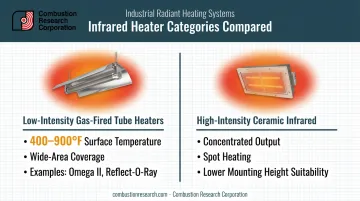
- Low-intensity gas-fired tube heaters (CRC's Omega II and Reflect-O-Ray lines) run tube surface temperatures around 400–900°F, radiating heat gently across wide areas.
- Reflect-O-Ray's vacuum-vented Engineered Design Systems are custom-built for facilities from 500 sq ft to over a million square feet.
- Omega II's power-vented Pre-Engineered Packages ship ready to hang for simpler installs.
- High-intensity ceramic infrared burns gas at a porous ceramic surface for more concentrated output, suited to spot heating or lower mounting heights.
CRC backs its Omega II, Reflect-O-Ray, and Serengeti-IR tube systems with a 10-year limited warranty on internally created corrosion and CSA International Design Certification to ANSI/CGA standards. That certification reflects engineering built to withstand industrial duty cycles.
Use Cases of Infrared Heating
Infrared fits naturally into operations where doors open often and ceilings run high:
- Warehouses and distribution centers
- Aircraft hangars and MRO facilities
- Auto dealership service bays and CNG repair shops
- Loading docks and shipping/receiving areas
- Animal confinement barns and greenhouses
- Ice arenas, where radiant heat warms spectators without heating the ice sheet
According to a 2007 ASHRAE Journal engineering assessment, infrared heaters used about half the energy required by unit heaters to maintain the same occupied-zone temperature in a 20-foot-high test building, producing vertical temperature gradients less than half as large. Results like this depend heavily on ceiling height and insulation, but the mechanism holds across most high-bay applications.
What Is Convection Heating?
Convection heating warms air through a heat source, then circulates that warm air through natural rising or forced fans. It's the mechanism behind furnaces, unit heaters, and radiators, and it works reasonably well in small, tightly sealed rooms where the air volume is limited and doesn't escape often.
Where convection holds its own:
- Even air temperature throughout a sealed, enclosed room
- Widely available, familiar equipment for installers and technicians
- Simpler heat load calculations for fixed, enclosed volumes
Common Subtypes
- Forced-air furnaces: self-contained units delivering heated air through ductwork
- Unit heaters: fan-driven heaters that circulate air over a heat exchanger within the space itself
- Convector radiators: hot-water or steam terminal units that warm a room primarily through air movement
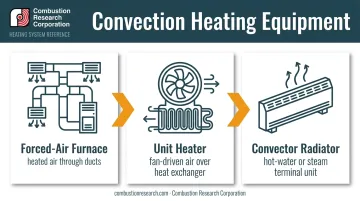
Each behaves differently in terms of heat-up time and air distribution, but all three share the same weakness: they heat the air, and that air has to go somewhere.
Use Cases of Convection Heating
Convection still makes sense in specific settings:
- Small offices and enclosed break rooms
- Well-insulated retail spaces with limited air exchange
- Compact, sealed workshops with low ceilings
The trouble starts when convection gets applied to large or drafty industrial spaces. Warm air rises and pools near the roof deck, doing little for workers at floor level.
A peer-reviewed 2017 warehouse destratification study found that an 8°C vertical temperature difference in one hangar required 38% extra heating energy just to compensate. That's the real-world cost of heating air that never reaches the occupied zone.
Infrared vs Convection Heating: Which Is Better?
Neither system wins by default. The right answer depends on a handful of building-specific factors:
- Ceiling height: infrared tends to perform best above roughly 16 feet, while convection struggles more as ceilings climb.
- Insulation quality — poorly insulated roofs amplify convection losses, though they also blunt some of infrared's advantage.
- Door and dock opening frequency: every cycle displaces heated air, and infrared's stored radiant heat recovers faster than reheated air does.
- Facilities with dust, chemical fumes, or airborne particulates benefit from infrared's lack of air movement.
- Ceiling-mounted infrared also frees up floor space that floor-mounted convection units typically occupy.
General guidance: choose infrared for high-ceiling, drafty, or frequently-opened spaces like warehouses, service garages, and hangars. Choose convection for small, sealed rooms with steady occupancy and minimal air exchange.
Real-World Example: Auto-Service Garage Retrofit
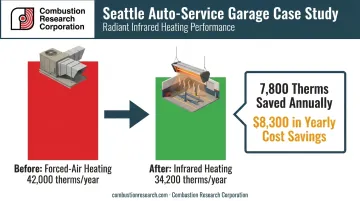
A Seattle-area auto-service garage with 18–20-foot ceilings offers one of the clearest documented conversions. The facility had been running forced-air gas unit heaters, burning roughly 42,000 therms per year, and dealing with the usual symptoms: cold floors, uneven comfort, and heat loss every time a bay door opened.
After switching to infrared heaters, the facility reported savings of 7,800 therms annually, worth more than $8,300 per year at the time's gas rates, according to the ACEEE case study on infrared heating conversions. That's notable because the post-installation period was actually colder than the baseline year.
Staff also reported the space felt noticeably more comfortable, with less disruption from door cycling.
The lesson isn't that infrared always wins automatically. The same study documented a poorly insulated machine shop where an undersized, poorly distributed infrared install failed to hold temperature, and forced-air heaters had to be reinstated as backup. Sizing and layout matter as much as the technology itself.
That's the gap CRC's engineering support is built to close. Whether you're specifying new construction or evaluating a retrofit, working through heat loss calculations, mounting height, and zoning with an experienced team helps avoid the underdesign problems that undercut infrared's advantages.
If your facility is weighing this switch, connect with a local CRC representative for a facility-specific assessment.
Conclusion
Neither infrared nor convection heating is universally better. Infrared tends to win in large, open, or high-traffic industrial spaces where direct, efficient heat matters and floor space is valuable. Convection can still do the job in smaller, enclosed, well-insulated rooms with predictable occupancy.
What decision-makers care most about are the outcomes: lower energy costs, less maintenance, better safety around forklifts and machinery, and floor space you can actually use. CRC has spent over 50 years engineering durable infrared systems for exactly these demanding facilities. That experience shows up in every Omega II and Reflect-O-Ray install running in warehouses, hangars, and service garages today.
Frequently Asked Questions
Is infrared heating cheaper to run than convection heating?
In large or drafty spaces, yes. Infrared doesn't waste energy heating air that escapes through open doors, and CRC customers commonly see 30-50% lower operational costs compared to conventional forced-air systems.
Can infrared heaters replace convection heaters in a warehouse?
In most cases, yes. Warehouses typically have high ceilings and frequent dock door activity, both of which favor infrared. Ceiling-mounted infrared also frees up floor space for storage and equipment movement.
Do infrared heaters affect air quality differently than convection heaters?
Yes. Infrared doesn't circulate air, so it avoids stirring up dust, allergens, or airborne pathogens. Convection systems rely on air movement, which can spread contaminants throughout the space.
How much energy can infrared heating save compared to convection heating?
Savings typically fall in the 30-50% range for most facilities, climbing toward 75% in well-insulated buildings with minimal door traffic. Ceiling height, insulation quality, and dock activity all influence where a facility lands in that range.
What is the main difference between infrared and convection heat?
Infrared directly heats objects, floors, and people using radiant waves, similar to sunlight. Convection heats the surrounding air first, then relies on circulation to distribute warmth.
Which heating type is better for large industrial spaces with high ceilings?
Infrared is generally preferred for high-ceiling spaces because it delivers heat directly to floor level instead of letting warm air rise and collect near the roof, where it does little good.