Key Takeaways
- Gas-fired heating systems burn natural gas or propane and distribute heat via forced air, radiant infrared, or hot water/steam loops.
- Four main system types exist: furnaces, boilers, unit heaters, and infrared tube heaters — each suited to different building sizes and applications.
- Infrared tube heaters reduce operational costs by 30–50% compared to conventional heating in large commercial and industrial spaces.
- CO detection, annual professional inspections, and proper venting are non-negotiable safety requirements for any gas-fired installation.
How Gas-Fired Heating Systems Work
Every gas-fired heating system combusts fuel, captures the heat, and moves it into the occupied space. How that heat transfers — and how much energy is lost along the way — depends entirely on the system type.
The Combustion Cycle
Natural gas or propane ignites at the burner, generating a flame. That heat then transfers to the building through one of three mechanisms:
- Heat exchanger: in forced-air furnaces, combustion heat warms an exchanger; a blower then moves indoor air across it and through ductwork
- Water or steam loop: boilers heat water or generate steam that circulates through radiators or radiant floor systems
- Direct radiant emission: infrared tube heaters emit energy that warms objects, floors, and occupants directly without heating the air first
The fuel-to-heat transfer method determines not just comfort but also how much energy is wasted through air stratification, door cycles, and building infiltration.
Ignition Sequence
Modern gas-fired systems use electronic ignition (intermittent ignition devices) rather than standing pilot lights, cutting fuel waste and reducing ignition-related safety risks. The typical sequence:
- Thermostat calls for heat
- Control board activates the draft-induced fan
- Ignition switch fires
- Gas valve opens; burner lights
- Heat exchanger reaches operating temperature
- Blower or distribution mechanism moves heat into the space
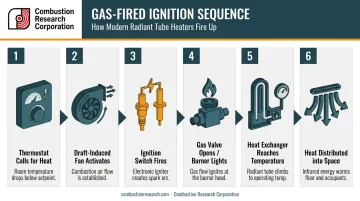
How well that sequence converts fuel into usable heat is measured by AFUE — which brings the condensing vs. non-condensing distinction into focus.
Condensing vs. Non-Condensing Configurations
AFUE (Annual Fuel Utilization Efficiency) is the standard metric for comparing furnace and boiler performance. It expresses the percentage of fuel converted to usable heat over a heating season.
| Configuration | How It Works | Efficiency Range |
|---|---|---|
| Non-condensing | Exhausts flue gases at high temperature through a standard flue | Typically 80–83% AFUE |
| Condensing | Secondary heat exchanger extracts additional heat from exhaust before venting | Can exceed 90% AFUE |
Venting Options and Installation Implications
In industrial buildings — warehouses, hangars, and shops with pressurized interiors or limited roof penetrations — venting configuration directly affects both installation complexity and long-term safety:
- Natural draft: relies on buoyancy and stack effect; draws combustion air from indoors
- Power-vented (induced draft): a fan pushes or pulls flue gases; can handle longer exhaust runs
- Sealed combustion (direct vent): uses dedicated outdoor air intake and exhaust paths, decoupling combustion from indoor air and reducing backdraft risk
Types of Gas-Fired Heating Systems
Forced-Air Furnaces
Forced-air furnaces heat a heat exchanger and distribute warm air through ductwork via a blower. They're the most common choice in residential and light commercial settings. In industrial spaces, the ductwork requirement becomes impractical, and the air circulation can stir up dust, fumes, or airborne particles — a real drawback in manufacturing or food-processing environments.
Gas-Fired Boilers
Boilers heat water (hydronic, or water-based, systems) or produce steam that circulates through radiators or radiant floor loops. They deliver even, consistent heat and are common in older commercial and institutional buildings. Steam systems require more maintenance attention than hot water configurations — and the piping infrastructure represents a significant upfront investment either way.
Gas-Fired Unit Heaters
Unit heaters are self-contained, ceiling- or wall-mounted heaters that burn gas and blow heated air directly into a space — no ductwork required. They're widely used in warehouses, service garages, and loading docks. Installation is straightforward and they work well for localized heat. In very large or high-bay spaces, though, warm air stratification near the ceiling limits their effectiveness.
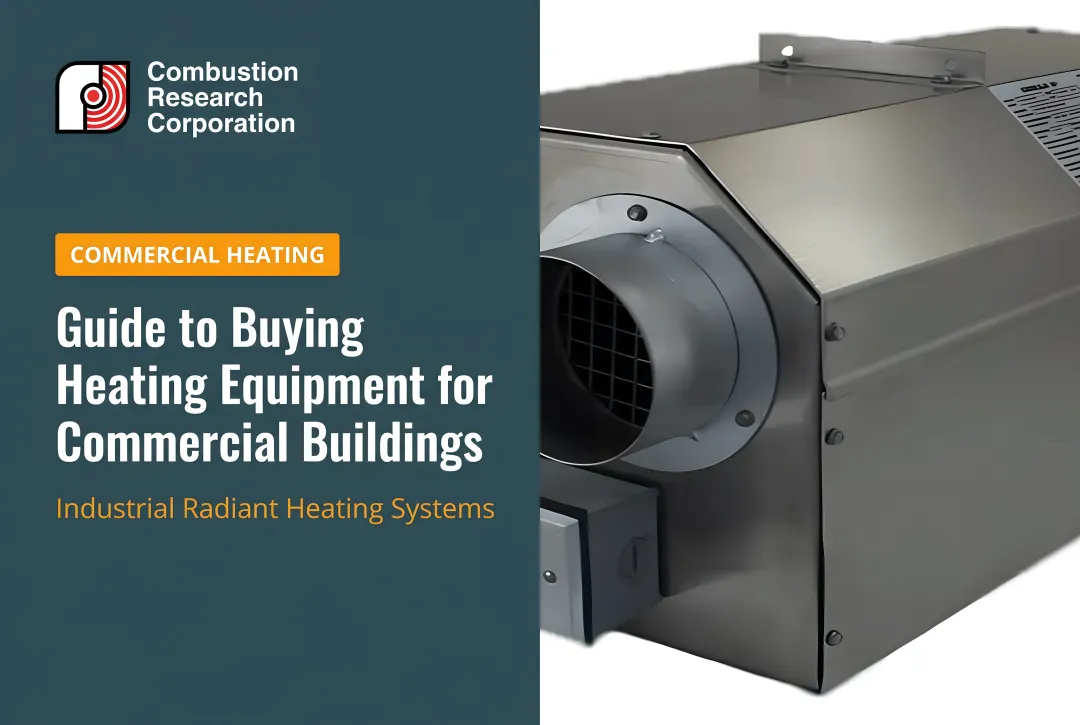
Gas-Fired Infrared Tube Heaters
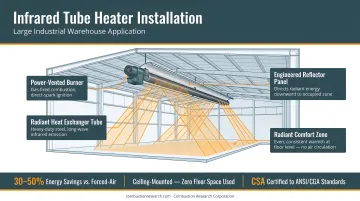
Rather than heating air, ceiling-mounted infrared tube heaters emit radiant energy that directly warms objects, equipment, floors, and people — similar to how sunlight warms you on a cold day. Because they don't rely on air temperature, drafts, open dock doors, or 30-foot ceilings don't defeat them.
This makes them the preferred choice for:
- Aircraft hangars
- Warehouses and distribution centers
- Auto dealerships and service garages
- Shipping and receiving docks
- Automotive repair and CNG service facilities
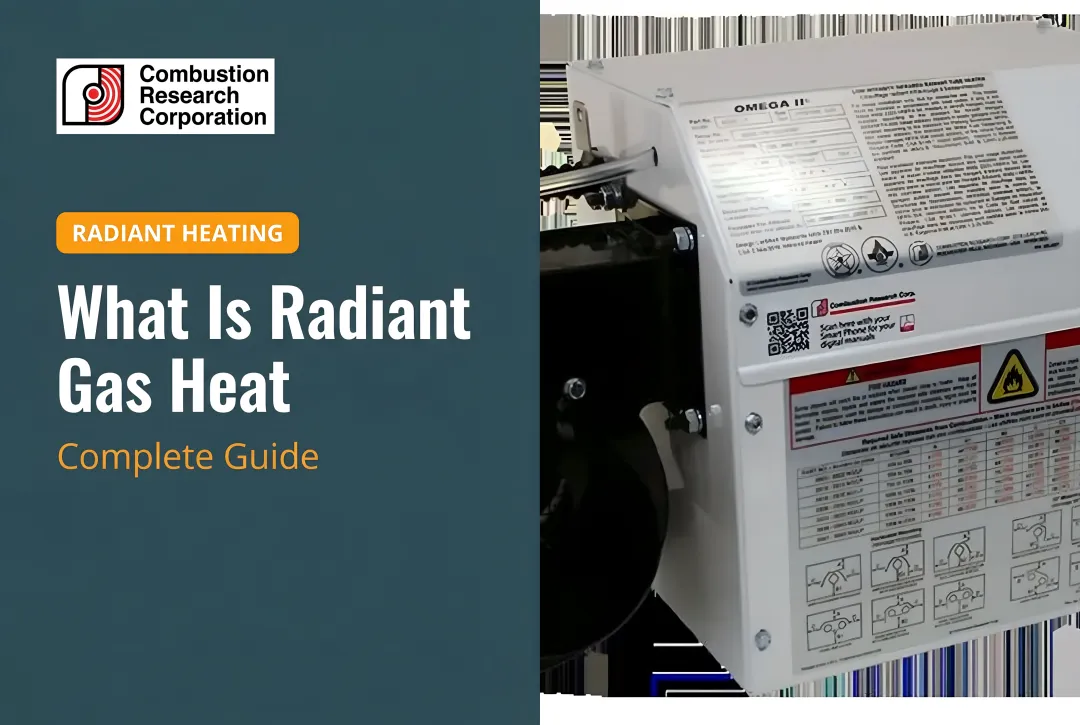
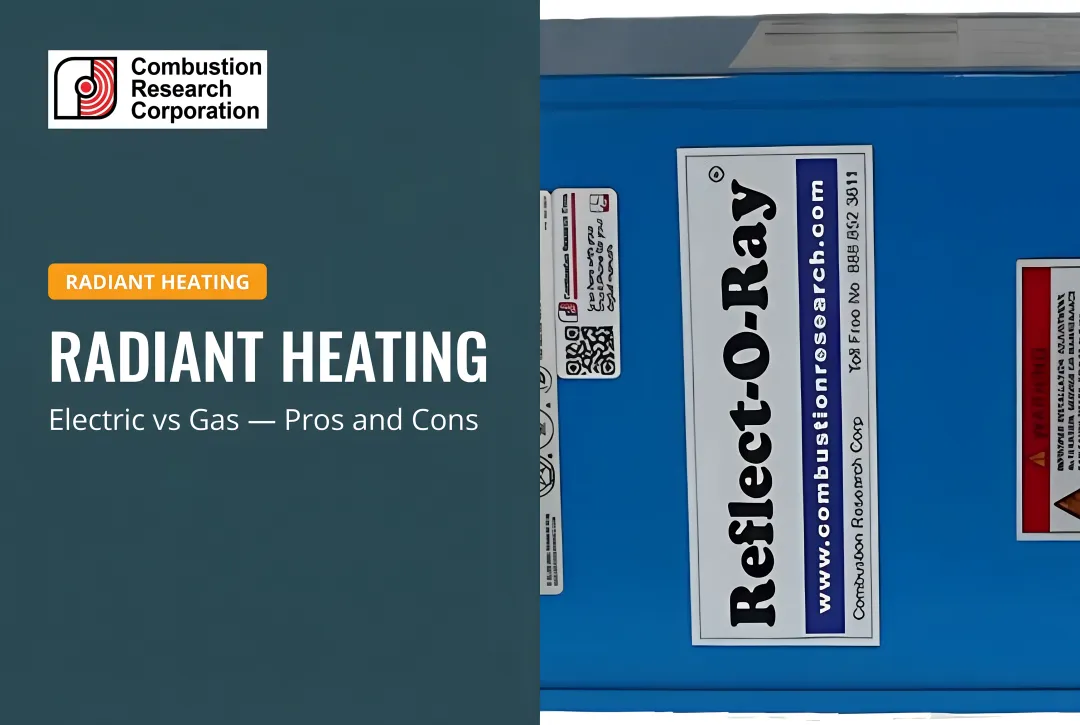
Combustion Research Corporation's low-intensity infrared tube heaters are built for exactly these environments, available in vacuum-vented (Reflect-O-Ray) and power-vented (Omega II) configurations. These systems require no built-in combustion air filters — a practical advantage in dusty industrial settings where filter maintenance adds up.
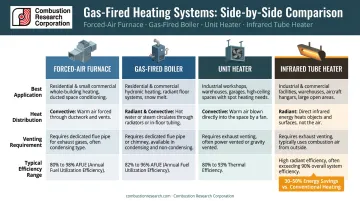
Quick Comparison
| System Type | Best Application | Heat Distribution | Venting Need | Typical Efficiency |
|---|---|---|---|---|
| Forced-air furnace | Residential, light commercial | Ductwork/blower | Flue/chimney | 80–95% AFUE |
| Boiler | Older commercial, institutional | Water/steam piping | Flue/chimney | 80–90% AFUE |
| Unit heater | Warehouses, garages, docks | Direct forced air | Individual flue | 80–83% thermal |
| Infrared tube heater | High-bay industrial, hangars | Radiant emission | Shared or individual | 30–50% energy savings vs. forced air |
How to Choose the Right Gas-Fired Heating System
Get the BTU Sizing Right
Sizing errors are expensive in both directions. An undersized system runs continuously on cold days, drives up utility costs, and wears out faster. An oversized system short-cycles — meaning it fires, reaches setpoint quickly, shuts off, then fires again — creating temperature swings and reducing lifespan.
Proper sizing requires a formal heat load calculation based on:
- Building dimensions and ceiling height
- Insulation values and construction type
- Climate zone and outdoor design temperature
- Infiltration sources (dock doors, loading bays, gaps)
For commercial and industrial applications, ACCA Manual N is the standard load calculation procedure. Work with a qualified engineer or manufacturer's engineering support team rather than relying on rules of thumb. Combustion Research Corporation, for example, offers engineering support throughout the specification process — performing heat loss calculations and designing custom systems before construction begins.
Application-Specific Selection Factors
Once sizing is confirmed, the application itself shapes which system type fits best. Building height is often the deciding factor in industrial settings:
- High-bay spaces above 14 feet — infrared tube heaters are more effective because warm air rises and is wasted; radiant energy reaches people and floors regardless of ceiling height
- Low ceiling spaces — unit heaters or furnaces work well
Beyond ceiling height, several operational realities push facilities toward infrared over forced-air:
- Frequent door openings (docks, hangars) — radiant-warmed floors act as a heat reservoir after doors close, while forced-air systems lose heated air immediately
- Air quality concerns — environments with dust, fumes, or pathogens benefit from systems that don't circulate air
- Floor space constraints — ceiling-mounted systems preserve floor clearance for forklifts and material handling
Fuel availability also shapes the decision. Natural gas requires pipeline access; propane requires delivery infrastructure and on-site storage. The DOE notes propane demand can run 2 to 3 times higher in winter than summer, so storage capacity planning matters for propane-dependent facilities. Confirm fuel availability and local code requirements before specifying any system.
Energy Efficiency and Cost Savings
Federal Efficiency Minimums
For commercial applications, the DOE sets legal efficiency floors:
- Commercial gas warm-air furnaces (≥225,000 BTU/h): 81% thermal efficiency for equipment manufactured on or after January 1, 2023
- Commercial gas hot-water boilers (300,000–2,500,000 BTU/h): 80% Et
- Commercial gas hot-water boilers (>2,500,000 BTU/h): 82% Ec
High-efficiency condensing units — often used in commercial office and institutional settings — can exceed 90% AFUE. AFUE applies to furnaces and boilers; infrared heaters are evaluated differently, based on their radiant efficiency and delivered-heat performance in the actual space.
Why Infrared Saves More Energy in Industrial Spaces
In large industrial buildings, infrared systems outperform forced air for a straightforward reason: they don't waste energy heating empty space.
Forced-air systems must heat the entire air volume of a building before occupants feel comfortable. In a 40-foot-high warehouse, most of that heated air stratifies near the ceiling where it does nothing useful. Infrared systems heat floors, equipment, and people directly. When a dock door opens, radiant-warmed floors retain heat and recover faster than a forced-air system that just lost its entire heated air volume.
Documented field data shows gas-fired infrared heating can save 20% to 50% in fuel consumption compared to forced air in large commercial spaces. One hangar installation recorded 30% less BTU input than the unit heaters it replaced, with equipment payback in under two years.
Those results align with what Combustion Research Corporation's infrared tube heaters deliver in practice — 30–50% operational cost savings over conventional systems. The Omega II DI PEP line achieves this through True Dual Modulating technology, which adjusts both gas and air simultaneously across two firing stages to match actual heat demand rather than cycling at full output.
Retrofit Upgrades for Existing Systems
If replacing a system isn't in the budget, these upgrades improve what you already have:
- Intermittent ignition devices (IIDs) — replacing a continuous pilot light saves 3% to 5% in fuel, per DOE retrofit guidance
- Modulating aquastats on hot-water boilers — adjust supply water temperature based on outdoor conditions, saving 5% to 10%
- Programmable thermostats — setbacks of 7–10°F for 8 hours per day can save approximately 10% annually on heating costs
- Vent (flue) dampers — reduce standby heat loss when the system isn't firing; savings vary by system and building type
Safety and Maintenance Best Practices
Carbon Monoxide: The Primary Risk
CO is colorless, odorless, and produced by incomplete combustion. OSHA identifies a workplace permissible exposure limit of 50 ppm over an 8-hour shift. That threshold can be exceeded faster than occupants realize — early symptoms like headache, dizziness, and nausea are easily dismissed as unrelated illness.
The three primary causes in gas-fired systems:
- Cracked or corroded heat exchanger
- Blocked or damaged venting
- Incomplete combustion from a dirty or misadjusted burner
CO detectors are mandatory — not optional — in any gas-heated building. Placement requirements vary by occupancy type under NFPA 101 and NFPA 72; confirm applicable local code requirements for your facility.
Physical safety note: Ceiling-mounted systems like infrared tube heaters and unit heaters eliminate floor-level heat sources that create collision hazards with forklifts and material-handling equipment — a direct safety advantage in high-traffic industrial facilities.
Annual Maintenance Checklist
Schedule professional service before each heating season. Key inspection tasks:
- Inspect and clean burner assembly
- Check heat exchanger for cracks or corrosion
- Test and clean flame sensors
- Inspect venting and flue for blockages or damage
- Verify gas pressure and connections
- Test safety controls and limit switches
- Check ignition system function
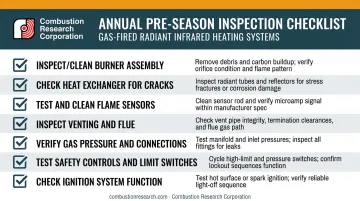
For facilities running low-intensity infrared tube heaters, the checklist above is typically shorter than with forced-air systems. With no built-in filters or condensation-prone components, there are fewer interventions at height and fewer consumables to track.
Certifications and Compliance
For commercial and industrial gas-fired equipment, verify:
- ANSI Z83.20 / CSA 2.34 certification for low-intensity infrared and radiant tube heaters
- Local code compliance for venting standards, especially for sealed combustion systems
- Annual inspection by a licensed technician (required by most jurisdictions for commercial systems)
Combustion Research Corporation's Omega II 9K Series carries ANSI Z83.20 / CSA 2.34 certification, and all product lines carry CSA certification — confirm this during specification to satisfy local authority having jurisdiction (AHJ) requirements.
Warning Signs Requiring Immediate Service
Don't wait for an annual inspection if you notice:
- Sulfur or rotten egg smell (gas leak)
- Yellow or orange burner flame instead of blue
- Soot or black marks around the unit
- Unexplained increase in fuel bills
- Rapid on/off cycling (short-cycling)
- Visible corrosion on heat exchanger or venting
Frequently Asked Questions
Is it cheaper to run a gas-fired heating system or central heating?
"Central heating" typically describes gas furnaces or boilers — so this is often a comparison within gas-fired systems rather than against them. Gas-fired systems generally cost significantly less to operate than electric resistance heating. Savings vary based on local fuel prices, system efficiency rating, and how well the building is insulated.
Are gas-fired heating systems being phased out?
Some states are restricting new gas appliance installations in residential construction — New York's fossil-fuel equipment restrictions for new buildings begin in 2026. Commercial and industrial gas-fired heating remains widely permitted, and phase-out timelines vary considerably by region and application type.
Can a gas-fired heating system make you feel dizzy?
A properly functioning, well-vented system should not. Dizziness is an early symptom of carbon monoxide exposure — which can result from incomplete combustion, a cracked heat exchanger, or blocked venting. CO detectors and annual professional inspections are the essential safeguards.
What is the average life expectancy of gas-fired heating systems?
Gas furnaces typically last 15–20 years; boilers 20–30 years. Well-built infrared tube heaters can last 20-plus years with proper maintenance. Correct sizing, installation quality, and regular servicing are the primary factors.
What is the most efficient gas-fired heating system for large industrial spaces?
Gas-fired infrared tube heaters. They heat occupants and objects directly rather than trying to heat the entire air volume of a high-bay building, which cuts energy waste from air stratification and minimizes losses during frequent door openings.
How often should a gas-fired heating system be serviced?
Annual professional inspection before the heating season is the baseline recommendation, per CDC guidance. Industrial systems in dusty or demanding environments benefit from more frequent checks. Any warning signs — unusual odors, inconsistent heating, or flame color changes — warrant immediate inspection regardless of schedule.