Radiant heat and convection heat both warm buildings — but they do it through fundamentally different mechanisms, and in large commercial and industrial facilities, that difference translates directly into energy bills, worker comfort, and air quality. Choosing the wrong system for your building type can mean thousands of dollars in avoidable operating costs every year.
This guide breaks down how each system works, where each performs best, and how to make the right call for your specific facility.
Key Takeaways
- Radiant heat warms objects and people directly via infrared waves; convection warms air, which then circulates to heat the space
- In high-ceiling industrial buildings, convection systems lose significant heat to stratification — warm air pools at the ceiling, away from workers and equipment
- Ceiling-mounted low-intensity infrared tube heaters can reduce energy costs by 30–50% compared to conventional forced-air heating
- Convection works better in smaller, well-insulated spaces with low ceilings where quick air warm-up is the priority
- The right choice depends on ceiling height, building size, ventilation, and door-opening frequency — no single system fits every facility
Radiant Heat vs. Convection Heat: Quick Comparison
| Factor | Radiant Heat | Convection Heat |
|---|---|---|
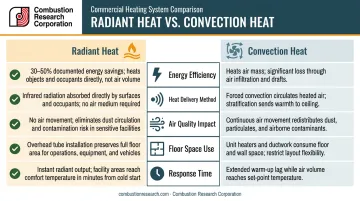
| Energy Efficiency | Heats objects directly; minimal stratification losses | Heats air volume first; significant losses in high-ceiling spaces |
| Heat Delivery | Infrared waves travel directly to surfaces and people | Air heated by furnace or fan coil, distributed via airflow |
| Air Quality | No air movement; doesn't stir up dust, allergens, or pathogens | Relies on circulation, which spreads airborne particles |
| Floor Space | Ceiling-mounted systems preserve full floor area | Ductwork, vents, and baseboards limit layout flexibility |
| Response Time | Immediate warmth to people and objects in its path | Fast in small enclosed spaces; slow in large or open areas |
What Is Radiant Heat?
Radiant heat transfers thermal energy through electromagnetic infrared waves that travel directly from the source to objects, surfaces, and people — no air required. The analogy is the sun: on a cold clear day, you feel warmth standing in direct sunlight even when the air temperature is low. The same mechanism applies inside any large commercial facility.
The Physics Advantage
The heat transfer equation tells the story. Convective heat transfer grows roughly linearly with temperature difference: q_c = h(T - T_o). Radiant heat transfer, governed by the Stefan-Boltzmann law, follows q_r = ε × σ × (T⁴ - T_o⁴) — a fourth-power relationship with absolute temperature. As source temperature rises, radiant output increases far more steeply than convective output. In practice, that means infrared systems deliver effective heat at lower thermostat settings than forced-air alternatives — a difference that shows up directly on utility bills.
How It Works in Industrial Settings
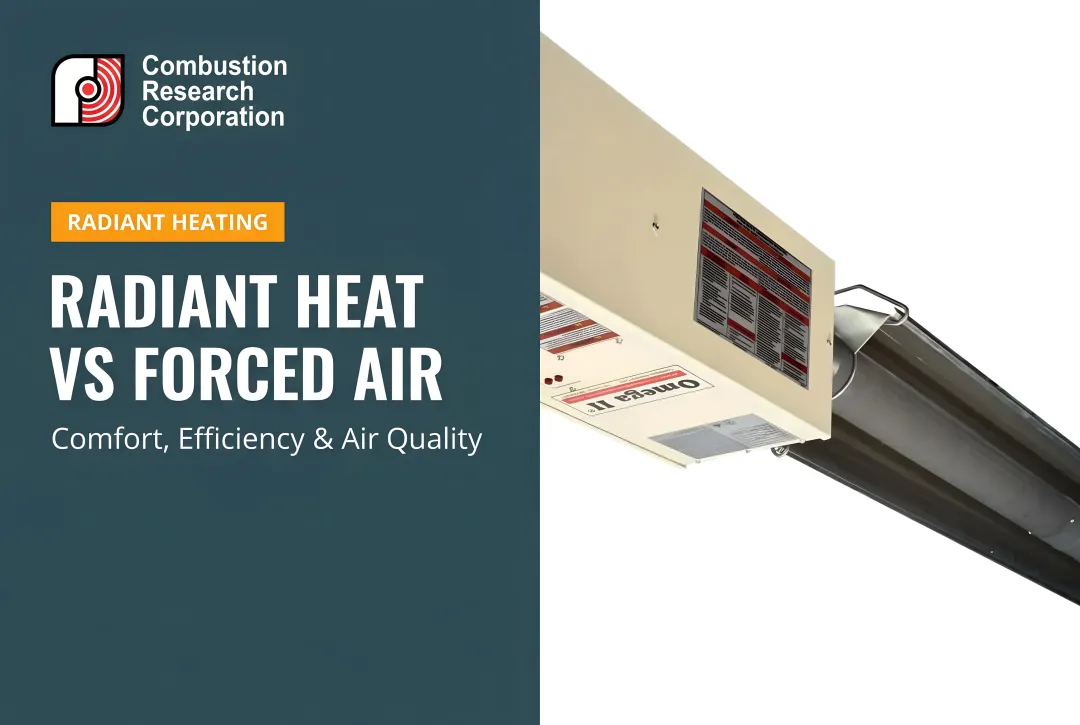
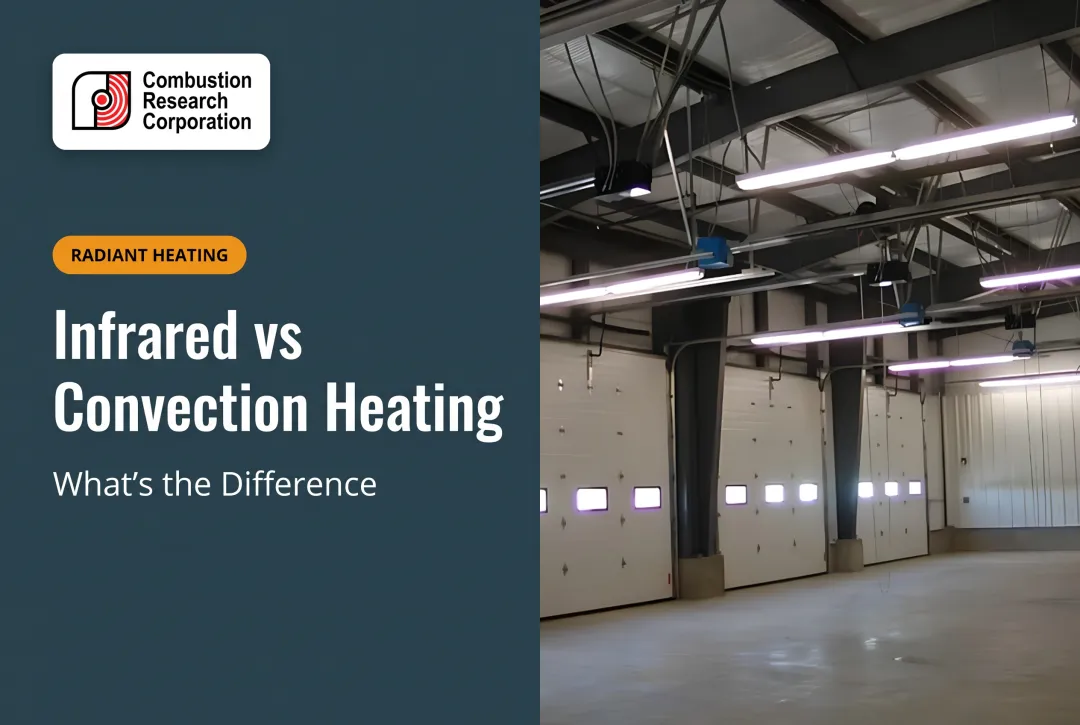
In commercial and industrial facilities, radiant heat is most commonly delivered via ceiling-mounted low-intensity infrared tube heaters. A gas burner heats a long steel tube to approximately 400–900°F; reflectors redirect that infrared energy downward to the occupied floor zone. Workers, equipment, inventory, and the floor itself absorb the energy directly — independent of ambient ceiling air temperature.
Key operational advantages for facilities:
- No air stratification — heat stays in the zone where it's needed
- No filters to maintain or replace
- No moving air to disturb dust, particulates, or contaminants
- Ceiling-mounted installation preserves full floor space for operations and machinery
Use Cases for Radiant Heat
Radiant heating is the standard specification for large-footprint, high-ceiling industrial environments:
- Warehouses and distribution centers
- Aircraft hangars (FBO, MRO, military)
- Automotive dealership service bays and service garages
- Shipping and receiving docks
- Car and truck wash bays
- Greenhouses and agricultural buildings
- Natatoriums and ice arenas
- Military vehicle bays and MRO facilities
- Pole barns and animal confinement buildings
ASHRAE's 2024 Handbook — HVAC Systems and Equipment dedicates a full chapter to infrared radiant heating, confirming its established role in commercial and industrial HVAC design.
Combustion Research Corporation manufactures low-intensity infrared tube heaters in both vacuum-vented (Reflect-O-Ray, 40K–250K BTU) and power-vented (Omega II, 40K–200K BTU) configurations. Both lines are CSA International Design Certified to ANSI Z83.20 / CSA 2.34 standards and carry a 10-year limited warranty on radiant tubes.
What Is Convection Heat?
Convection heating warms a space by heating air — via furnaces, fan coils, baseboard heaters, or unit heaters — which then circulates through the room via natural or forced airflow. It's the dominant heating method in residential construction and small commercial spaces.
Why It Struggles in Large Industrial Spaces
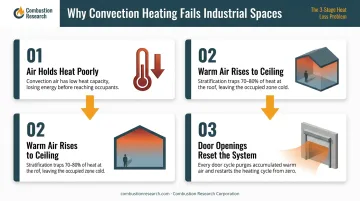
In high-ceiling industrial environments, convection systems face a three-stage efficiency problem:
- Air holds heat poorly: it absorbs and releases thermal energy quickly, so any heat delivered to air is also easily lost
- Warm air rises — lower-density heated air naturally migrates upward, pooling near the ceiling rather than staying in the occupied zone at floor level
- Every door opening resets the system: when a loading dock door opens, conditioned air escapes and must be entirely replaced, putting convection systems in a continuous cycle of recovery
A DOE field demonstration in a warehouse with approximately 24-foot ceilings measured ceiling air temperatures 10–20°F above the 60°F thermostat set point with conventional unit heaters — confirming that the warmest air in the building was concentrated exactly where it was least useful. That DOE field report also found that reducing stratification alone could account for 10–15% in heating energy savings.
Where Convection Does Perform Well
Convection systems are appropriate in:
- Small, well-insulated spaces with low ceilings — residential homes, small offices, and retail environments where stratification is minimal
- Quick-response supplemental heating — open offices or retail where occupancy changes frequently and fast temperature adjustment matters more than efficiency
- Hybrid configurations — convection units serving enclosed offices or lobby areas adjacent to a radiant-heated warehouse bay
Radiant vs. Convection: Which Is Right for Your Facility?
Key Decision Factors
Before selecting a system, evaluate these building characteristics:
- Ceiling height — stratification losses compound above 16 feet, making this the single biggest variable in system selection
- Building square footage — every percentage point of efficiency loss scales with floor area
- Insulation quality — poorly insulated envelopes drain any heating system faster
- Door opening frequency — loading docks with frequent cycles dramatically favor radiant systems
- Air quality requirements — facilities with dust, pathogens, or sensitive environments benefit from radiant's no-circulation design
- Occupancy pattern — continuous occupancy favors radiant; intermittent use may justify supplemental convection instead
The Ceiling Height Factor
ASHRAE Journal identifies radiant infrared as particularly effective in spaces with ceilings exceeding 16 feet — above this threshold, heat stratification from convection systems becomes economically significant. CRC's engineering guidance specifies the Reflect-O-Ray 6.0 EDS for any facility at 20 feet and above.
BTU sizing benchmarks illustrate the gap directly: insulated low-bay warehouses at 16-foot ceilings require 25–40 BTU/sq ft, while high-bay uninsulated warehouses at 20–30 feet require 40–65 BTU/sq ft. That's a potential doubling of energy demand — and the difference widens every year on your utility bill.
When to Choose Radiant
Those BTU figures point to a clear pattern. Radiant is the stronger choice when:
- Ceilings exceed 16 feet in warehouses, hangars, or service garages
- Air quality is critical — animal confinement, food-adjacent spaces, or greenhouses
- Floor space must stay fully clear for equipment and vehicles
- Energy cost reduction is a primary operational priority
- Overhead door cycling is frequent, regularly purging conditioned air
When to Choose Convection (or a Hybrid)
- Heating a small, well-insulated space with ceilings under 10 feet
- Quick temperature response is the main need (small offices, retail)
- Structural obstructions prevent consistent radiant coverage overhead
- Supplemental heating in enclosed offices within a larger radiant-heated facility
Real-World Example: Radiant Heat in an Auto Dealership Service Garage
An ACEEE case study documented a Seattle-area auto dealership service garage with 18–20 foot ceilings that replaced forced-air gas unit heaters with infrared radiant heaters.
Before the switch:
- Annual gas consumption: 42,000 therms
- Complaints of uneven heat — floor zones cold despite the system running continuously
After installing infrared:
- Annual gas consumption dropped to 34,200 therms
- Annual savings: 7,800 therms and $8,300
- Staff reported the garage as more comfortable
- Project cost: approximately $40,000, with a simple payback of under five years
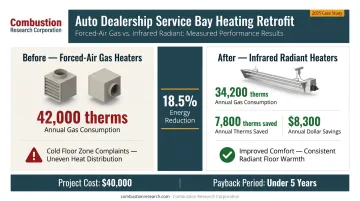
The facility had been paying full price to heat ceiling air that was doing no useful work. Once infrared delivered heat directly to the floor zone where vehicles and technicians actually operate, the 18.5% reduction in gas consumption came with a comfort improvement — not a tradeoff.
If your facility shares those characteristics — high ceilings, frequent door cycles, persistent cold zones at floor level despite a running system — the energy and comfort gap is worth quantifying with a formal heat loss analysis.
Combustion Research Corporation provides engineering consultation for new construction and retrofit projects through its North American representative network. To connect with a local rep:
- Phone: 888-852-3611
- Email: info@combustionresearch.com
- Web: combustionresearch.com
Conclusion
Neither radiant nor convection heat is universally superior — but for most industrial and commercial facilities, the comparison is far from equal.
For large, high-ceiling industrial and commercial facilities — warehouses, hangars, service garages, natatoriums — radiant heat wins on energy efficiency, air quality, floor-level comfort, and long-term operating cost. Convection remains practical for smaller, well-sealed spaces with low ceilings, or as supplemental heating in hybrid configurations.
That application-specific difference compounds over time. In an industrial environment running year-round, the wrong heating system doesn't just cost more this winter — it costs more every winter, for the life of the building. Getting the specification right from the start, or building the case for a retrofit, has a direct dollar value. Manufacturers like Combustion Research Corporation provide engineering support through the specification process precisely because the upfront analysis pays for itself many times over in avoided operating costs.
Frequently Asked Questions
Is radiant heat or convection heat better?
For large industrial and commercial spaces with high ceilings, radiant heat is the more efficient choice — it delivers heat directly to the occupied zone and eliminates stratification losses. Convection works better in smaller, well-insulated spaces where ceiling heights are low and quick air warm-up is the priority.
Which is healthier: radiant heat or convection heat?
Radiant heat is the healthier option in industrial environments because it doesn't circulate air — so it doesn't spread dust, allergens, or airborne pathogens. This is a clear advantage in animal confinement buildings, greenhouses, food-adjacent facilities, and any space where air quality directly affects occupants or products.
How does radiant heat perform in spaces with very high ceilings?
Radiant heat is particularly well-suited to high-ceiling spaces because infrared energy travels directly downward to the occupied zone without heating the full air volume above it. Convection heat rises and pools near the ceiling in tall buildings, wasting energy on unoccupied space — a problem that worsens as ceiling height increases.
Is radiant heating more expensive to install than convection heating?
Radiant tube heaters typically carry higher upfront costs than convection units, but documented operating savings of 30–50% generally produce payback periods of two to five years. Engineering support during specification — to correctly size the system for your building — is essential to hitting those numbers.
Can radiant heat and convection heat be used together?
Yes. Hybrid configurations are common: a radiant infrared system serves as the primary heat source across the main facility floor, while convection units provide supplemental warmth in smaller enclosed offices or entry vestibules.
What types of commercial buildings benefit most from radiant heating?
Radiant heating delivers the strongest return in warehouses, aircraft hangars, auto dealership service bays, shipping and receiving docks, service garages, car and truck wash bays, greenhouses, pole barns, natatoriums, and any large facility with high ceilings and frequent overhead door openings.