An unheated patio doesn't just turn cold — it turns guests away. Shorter dwell times, empty tables through fall and winter, and competitors with better-heated terraces stealing your covers. The right commercial patio heater is infrastructure, not an accessory.
This guide covers the five best commercial patio heaters for restaurants in 2026, what separates commercial-grade units from residential ones, and the key criteria every restaurant operator should evaluate before buying.
Key Takeaways
- 35% of restaurants with outdoor seating earn more than 40% of daily sales from that space — heating it is revenue protection
- Commercial-grade heaters are rated for continuous operation and carry safety certifications that consumer models don't — a requirement for any occupied public space
- Infrared systems heat guests directly, not surrounding air — significantly more efficient in open or semi-open spaces
- Overhead and wall-mounted heaters eliminate tip-over hazards and free up floor space in high-traffic dining areas
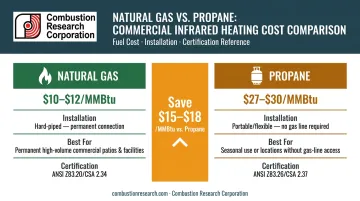
- Fuel type drives long-term operating costs: natural gas runs roughly $10–$12/MMBtu versus $27–$30/MMBtu for propane
Commercial Patio Heaters for Restaurants: What Sets Them Apart
Not all patio heaters are the same. A residential unit built for occasional backyard use will fail fast under nightly restaurant service — wrong materials, inadequate output, and missing certifications that local fire marshals often require.
Commercial-grade units differ in a few key ways:
- Continuous-duty engineering (built for nightly use, not weekend parties)
- Higher BTU output and wider coverage zones
- Heavier-gauge materials — stainless steel and powder-coated aluminum — for weather and wear resistance
- Safety certifications such as ANSI/CSA standards, required for many commercial permitting processes
- Fixed installation options (wall, ceiling, post-mount) suited to permanent patio setups
The Five Main Types for Restaurant Use
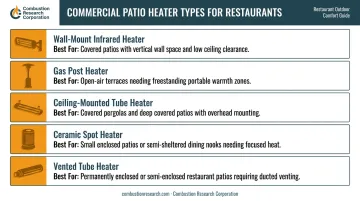
| Type | Best For |
|---|---|
| Wall/ceiling-mounted electric infrared | Semi-enclosed or covered patios; venues in areas restricting open flames |
| Natural gas post-mount (fixed) | Permanent high-volume operations with existing gas infrastructure |
| Low-intensity radiant tube (ceiling-mounted) | Covered and semi-covered patios; large commercial terraces with high clearance |
| High-intensity ceramic infrared | Spot heating under canopies; locations needing fast, targeted warmth |
| Power-vented gas radiant tube | Enclosed or semi-enclosed patios requiring vented combustion for code compliance |
Best Commercial Patio Heaters for Restaurants in 2026
These five heaters were evaluated against the criteria that matter most to restaurant operators:
- BTU output and coverage area
- Construction quality and weather resistance
- Safety certifications
- Fuel and operating costs
- Suitability for real commercial environments
1. Bromic Heating Tungsten Smart-Heat Portable Gas Heater
Bromic is an Australian brand with strong commercial traction in US hospitality, and the Tungsten Portable is among the most-recommended units by commercial outdoor specialists. Unlike omnidirectional mushroom heaters that waste heat in every direction, the Tungsten delivers directional radiant heat so warmth reaches where your guests are sitting, not the open sky above them.
Key specs:
| Specification | Detail |
|---|---|
| Fuel Type | Propane (LPG) or natural gas |
| BTU Output | 38,500 BTU/hr |
| Coverage Area | Up to 215 sq ft |
| Wind Resistance | Up to 8 mph |
| Certification | Intertek 4009079 |
| Warranty | 1 year (labor, shipping, and admin costs are owner's responsibility) |
Bromic claims up to 3× the efficiency of traditional mushroom heaters — a manufacturer claim, though the directional design logic supports it for patios where guests spread across multiple zones. The portable format suits seasonal or multi-zone setups where flexibility matters.
Best for: Open-air restaurant patios needing premium portable gas heat without permanent installation.
2. Bromic Eclipse Smart-Heat Electric Heater
Also from Bromic, the Eclipse is wall- or ceiling-mounted electric infrared suited to covered terraces, pergola settings, or urban patios where open flames are restricted or impractical.
Zero emissions keep it compliant with municipal restrictions. Three adjustable heat settings (33%, 66%, 100%), dimmable integrated LED lighting at 497 lumens/3000K, and smart control compatibility let staff manage heat zones remotely without interrupting service.
Key specs:
| Specification | Detail |
|---|---|
| Fuel Type | Electric (hardwired) |
| Output | 2,900 W |
| Voltage | 208V–240V (13.9A–12.1A depending on voltage) |
| Coverage Area | 121 sq ft |
| IP Rating | IP54 |
| Certification | SGS / NA SGSNA/21/GZ/00074 (verify ETL/CSA with your AHJ before specifying) |
| Warranty | 3 years |
Best for: Semi-enclosed patios, covered terraces, and urban venues where gas is restricted. The longest warranty of any unit on this list.
3. AZ Patio Heaters HLDS01-GTxx Pyramid Glass Tube Heater
The AZ Patio Heaters (also sold as Hiland) pyramid glass-tube model is one of the most widely distributed commercial-leaning patio heaters in the US. The enclosed glass flame column serves double duty: functional heat source and visual centerpiece.
Heat distributes at guest level (both sitting and standing) across roughly a 10-foot heating radius. The lower center of gravity versus top-heavy mushroom models also improves safety in busy dining rooms where staff move quickly between tables.
Key specs:
| Specification | Detail |
|---|---|
| Fuel Type | Propane (20 lb tank housed internally) |
| BTU Output | 40,000 BTU/hr |
| Tank Runtime | 8–10 hours on high |
| Safety Features | Thermocouple, anti-tilt device, protective guard |
| Certification | ANSI Z83.26-2014 / CSA 2.37-2014 |
| Warranty | 1-year limited |
Important caveat: Official AZ Patio Heaters materials describe this for outdoor entertaining rather than explicitly rating it commercial/restaurant-grade. Verify with your local Authority Having Jurisdiction (AHJ) before relying on it as your primary heating solution in a permitted commercial space.
Best for: Open patios where ambiance matters as much as warmth; flexible setups without permanent installation.
4. Sunpak S25 Natural Gas Post-Mount Heater
Sunpak has been a go-to for permanent commercial outdoor heating for decades. The S25 is specifically labeled "NOT FOR USE IN RESIDENTIAL DWELLINGS" , marking it explicitly as commercial-only.
The hard-piped natural gas connection eliminates the biggest operational headache of propane: running out mid-service and scrambling to swap tanks. For high-volume restaurants with established gas infrastructure, that reliability is worth the installation investment.
Key specs:
| Specification | Detail |
|---|---|
| Fuel Type | Natural gas (hard-piped installation required) |
| BTU Output | 25,000 BTU/hr |
| Coverage Area | Approx. 10 ft × 10 ft |
| Mounting | Wall or ceiling mount |
| Power Requirement | 24 VAC / 20 VA |
| Typical Mount Height | 8–9 ft |
| Warranty | Verify current warranty with Sunpak/AEI before purchasing |
Best for: Permanent, high-volume restaurant patios with existing natural gas lines. The most operationally seamless option for year-round use.
5. Combustion Research Corporation (CRC) Reflect-O-Ray Infrared Tube Heater
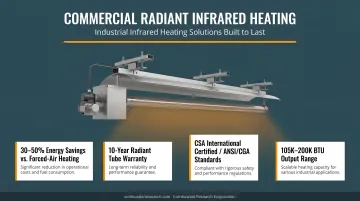
For covered and semi-covered commercial restaurant patios, CRC's Reflect-O-Ray represents an entirely different category: ceiling-mounted low-intensity infrared tube heating engineered for commercial-grade continuous operation.
CRC has manufactured radiant infrared heating systems for over 50 years, with applications spanning aircraft hangars, manufacturing facilities, ice arenas, and large commercial patios.
Their systems are CSA International Design Certified to ANSI Z83.20 / CSA 2.34, the specific standard applicable to gas-fired low-intensity infrared and radiant tube heaters.
What sets it apart:
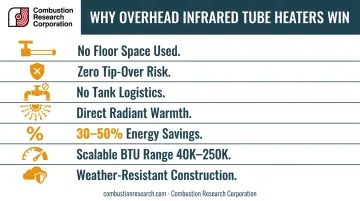
- No floor space consumed — system mounts overhead
- Zero tip-over risk — no units on your dining floor
- No tank logistics — operates on natural gas or propane via permanent connection
- Heats guests and surfaces directly with radiant warmth, without stirring air
- Documented energy savings of 30–50% over conventional heating systems
- Custom-engineered per patio — burner inputs from 40,000 to 250,000 BTU/hr, covering spaces from 500 sq ft to large commercial terraces
- Available in powder-coated or stainless steel construction for weather resistance
Key specs:
| Specification | Detail |
|---|---|
| Fuel Type | Natural gas or propane; vacuum-vented configurations |
| BTU Output | 40,000–250,000 BTU/hr (custom-engineered per space) |
| Coverage | Consult CRC engineering for your specific patio footprint |
| Certifications | CSA International Design Certified to ANSI Z83.20 / CSA 2.34 |
| Warranty | 10-year limited on Burner Core and all combustion/heat exchanger tubes; 3-year on ignition controls |
| Maintenance | No combustion air filters required; no recurring consumables |
The Reflect-O-Ray Engineered Design System is custom-specified, not off-the-shelf. CRC's engineering team works through heat loss calculations for your specific patio dimensions, ceiling height, and climate exposure to design the right system.
Many local commercial natural gas programs offer utility rebates that reduce the payback period meaningfully.
Best for: Covered or semi-covered restaurant patios requiring a permanent, certified, overhead heating solution built for commercial durability. Particularly well-suited for large patios where a single heater type won't cut it and engineered coverage matters.
How to Choose the Right Commercial Patio Heater
Common Mistakes Restaurant Operators Make
- Buying residential-grade units that fail under daily commercial use
- Choosing heaters based on purchase price without calculating fuel operating costs
- Selecting portable heaters for covered spaces where overhead systems are safer and more efficient
- Ignoring local permitting requirements — many jurisdictions require specific certifications for commercial outdoor heaters
Key Selection Factors
BTU output vs. coverage area. Use manufacturer coverage maps rather than generic BTU-per-sq-ft shortcuts. Open patios lose heat faster than covered ones, and wind further reduces effective range. Bromic, for example, recommends multiple heaters for large or windy areas rather than one oversized unit.
Fuel type and operating cost. EIA commercial natural gas pricing runs roughly $10–$12/MMBtu, while residential propane runs $27–$30/MMBtu, a meaningful difference across a full heating season. Natural gas wins on long-term economics wherever infrastructure exists.
Safety certifications. Look for ANSI Z83.26 / CSA 2.37 for gas-fired patio heaters, ANSI Z83.20 / CSA 2.34 for gas-fired infrared tube heaters, and ETL/UL listing for electric units. Many municipalities require these certifications for commercial permitting. Fairfax County, VA and St. Charles, IL both specify listing requirements for outdoor commercial heaters, so verify local codes before purchasing.
Installation type. Covered patios suit overhead or mounted systems. Open, seasonal patios suit portable gas units. Match the installation to the space, not the other way around.
The Infrared Efficiency Advantage
Both electric infrared and gas-fired infrared tube systems — such as CRC's Reflect-O-Ray — heat guests and surfaces directly, not the surrounding air. In open or semi-open environments, heated air simply dissipates before reaching anyone.
Radiant heat transfers to people and objects regardless of air movement. That's why infrared systems maintain effective warmth on a breezy patio where forced-air alternatives fail.
Conclusion
The right commercial patio heater is a business decision with a measurable return — one that keeps covers filled through fall and winter instead of draining your fuel budget or creating safety liability.
Evaluate total cost of ownership — installation, fuel, maintenance, and replacement parts — not upfront price alone. Match the heater type to your specific configuration: covered vs. open, permanent vs. seasonal, gas-accessible vs. electric-only.
For large covered restaurant patios that need a certified, overhead radiant heating system built for commercial use, contact Combustion Research Corporation to discuss the Reflect-O-Ray or Omega II for your specific space:
- Phone: 888-852-3611
- Email: info@combustionresearch.com
Frequently Asked Questions
Which commercial outdoor heater brands are best for restaurants?
The best choice depends on patio type. Bromic Tungsten or AZ Patio Heaters pyramid models work well for open or flexible layouts. Bromic Eclipse suits covered or semi-enclosed patios at the consumer end. For larger covered commercial terraces requiring an engineered system, CRC Reflect-O-Ray radiant tube heaters are specified by footprint and load — a different category from off-the-shelf brands. Sunpak S25 suits permanent high-volume operations with natural gas access.
What is the difference between a residential and a commercial patio heater?
Commercial units are built for continuous daily operation, handle larger coverage areas, and use heavier-gauge materials for weather and wear resistance. They typically carry commercial-grade certifications such as ANSI/CSA standards that may be required for local commercial permitting — certifications residential units often lack.
How many BTUs do I need for a restaurant patio?
Use manufacturer coverage maps rather than a generic BTU-per-sq-ft rule — open patios require more output than covered ones, and wind conditions reduce effective range. Plan for multiple heaters distributed across the space rather than one oversized unit, which delivers more consistent warmth at guest level.
Are natural gas or propane patio heaters better for restaurants?
Natural gas is generally preferred for permanent, high-volume operations — lower per-BTU fuel cost and no tank logistics. Propane suits seasonal or portable setups where gas lines aren't available. Both require proper commercial certification and compliance with local fire and building codes.
What safety certifications should a commercial restaurant patio heater have?
Look for ANSI Z83.26 / CSA 2.37 for gas-fired outdoor patio heaters, ANSI Z83.20 / CSA 2.34 for gas-fired infrared tube heaters, and ETL or UL listing for electric units. Built-in safety features — tip-over shutoff valves and thermocouple flame failure protection — are also typically required for commercial permitting.
How much do commercial patio heaters cost for a restaurant?
Freestanding portable gas units run roughly $300–$3,000+, with premium brands like Bromic at the top end. Fixed-mount units such as the Sunpak S25 start around $2,700 before installation; engineered overhead systems like CRC Reflect-O-Ray are quoted by facility footprint. Always factor in gas-line or electrical circuit installation, permitting, and AHJ inspection costs before comparing sticker prices.