Propane consumption varies considerably based on BTU rating, heater type, efficiency, and daily runtime. A residential patio heater and a 150,000 BTU industrial tube heater are completely different animals, and treating them the same way when estimating fuel costs leads to real problems.
This guide breaks down the consumption math, the variables that drive actual usage, and how to estimate propane needs for any infrared heating application — from a small service bay to a million-square-foot distribution center.
Key Takeaways
- A 30,000 BTU heater uses roughly 0.33 gallons/hour; a 100,000 BTU industrial heater uses about 1.09 gallons/hour — use the formula: BTU rating ÷ 91,500
- Actual consumption runs lower than nameplate ratings — thermostat cycling, modulation, and efficiency ratings all reduce fuel use
- BTU rating, heater efficiency, building insulation, and daily runtime are the biggest cost drivers
- Low-intensity infrared tube heaters typically use 30–50% less fuel than conventional forced-air systems in large commercial spaces
- Accurate propane budgeting requires a proper load calculation, not a rough square-footage estimate
How Much Propane Does an Infrared Heater Use?
Propane consumption doesn't follow a single fixed number. It depends on the heater's BTU input rating, its efficiency, and how many hours it runs. Getting this wrong means undersized tanks, emergency refills, or a heater that can't keep up with demand.
The Core Formula
Gallons per hour = BTU rating ÷ 91,452 BTUs per gallon
According to the U.S. Energy Information Administration, propane contains approximately 91,452 BTUs per gallon — the basis for all consumption math here.
Note: natural gas is measured in cubic feet (roughly 1,036 BTU/ft³), so dual-fuel heaters will show different consumption figures depending on which fuel source is in use.
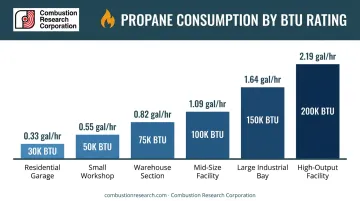
Propane Consumption by BTU Range
| BTU Rating | Gallons/Hour (Theoretical) | Approx. Lbs/Hour | Typical Application |
|---|---|---|---|
| 30,000 | 0.33 | 1.4 | Residential garage, patio |
| 50,000 | 0.55 | 2.3 | Small shop, barn |
| 75,000 | 0.82 | 3.4 | Mid-size service bay |
| 100,000 | 1.09 | 4.6 | Large garage, small warehouse |
| 150,000 | 1.64 | 6.9 | Warehouse section, hangar |
| 200,000 | 2.19 | 9.2 | Large industrial facility |
Lbs/hour based on 4.2 lbs/gallon at 60°F (PERC Technical Pocket Guide)
Residential and patio heaters typically fall in the 30,000–40,000 BTU range. Industrial infrared tube heaters used in warehouses, aircraft hangars, and service garages commonly operate between 75,000 and 200,000 BTUs.
Combustion Research Corporation's Omega II and Reflect-O-Ray product lines cover inputs from 40,000 up to 250,000 BTU/hr, designed specifically for this industrial range.
Theoretical vs. Real-World Consumption
The formula gives theoretical consumption at 100% efficiency. In practice, consumption is lower because:
- Modern infrared units typically operate at 80–95% thermal efficiency
- Thermostats cycle the heater off before it runs continuously
- Modulating heaters reduce output during mild conditions
- Radiant comfort effects allow lower air temperatures to feel warmer
A 100,000 BTU heater running at 90% efficiency effectively delivers 90,000 BTUs of usable heat per hour — so actual propane burned per degree of heating achieved is less than the raw formula suggests.
Key Factors That Affect Propane Consumption
BTU rating determines your baseline propane use, but operational and environmental variables can shift actual consumption well above or below that number.
BTU Rating and Heater Size
A heater's rated BTU output is the single largest determinant of hourly propane use. Larger spaces with higher ceilings demand higher-BTU heaters — but a properly sized unit heats the space faster and may run fewer total hours, sometimes producing similar or lower seasonal consumption than a smaller, constantly-running unit.
There's no universal BTU-per-square-foot rule that works across all industrial spaces. Ceiling height, insulation level, infiltration rate, and outdoor design temperature all affect the actual load.
A 10,000 sq. ft. warehouse with 30-foot ceilings and open dock doors needs substantially more BTUs per square foot than the same footprint with 12-foot ceilings and good insulation.
Heater Efficiency Rating
Thermal efficiency — the percentage of fuel energy converted to usable heat — varies by heater type. A unit operating at 90% efficiency delivers more heat per gallon than one at 80%, directly reducing fuel consumption for equivalent output.
Low-intensity infrared tube heaters have an advantage here. They heat objects, floors, and occupants directly through radiant energy rather than warming air that escapes through door openings and infiltration points. A 2007 study published in ASHRAE Journal found that in a 20-foot-high building, infrared heaters used 33–50% less energy than traditional unit heaters — a significant fuel cost advantage in facilities with frequent door cycles.
Modulating vs. Single-Stage Operation
Single-stage heaters run at full BTU output whenever they're on. Two-stage or modulating heaters can drop to a lower firing rate during milder conditions, burning less propane during low-demand periods.
Two-stage infrared systems can save a minimum of 12% in fuel costs compared to single-stage systems, according to manufacturer engineering data. The Omega II 9K Series True Dual Modulating heaters modulate both gas and air across high- and low-heat stages. Low-fire output runs approximately 30% below high-fire — reducing propane consumption directly during shoulder-season conditions when full capacity isn't needed.
Space Insulation, Thermostat Settings, and Runtime
Building envelope quality and runtime management both affect how many hours your heater runs — and how much propane it burns doing it:
- Building envelope: Poorly insulated spaces — older warehouses, open loading docks, minimally sealed bays — require heaters to run longer and more frequently. The DOE's Better Buildings initiative notes the building envelope accounts for roughly 30% of primary energy use in commercial buildings. Sealing drafts and improving insulation directly reduces propane consumption.
- Runtime management: Every additional hour of full-output runtime adds directly to fuel costs. Setback thermostats, zone controls, and occupancy-based scheduling reduce unnecessary runtime and are often the most cost-effective operational lever available.
Propane Consumption Breakdown: Hourly, Daily, and Seasonal
Consumption data at different time scales gives facility managers what they need to budget fuel, size tanks, and compare system costs before committing.
Hourly Consumption
Using the core formula at two common industrial BTU ratings:
- 50,000 BTU heater: 50,000 ÷ 91,452 = 0.55 gal/hr theoretical; approximately 0.49–0.50 gal/hr at 90% efficiency
- 100,000 BTU heater: 100,000 ÷ 91,452 = 1.09 gal/hr theoretical; approximately 0.98–1.00 gal/hr at 90% efficiency
Daily and Monthly Consumption
Daily usage = hourly consumption × operating hours per day. Monthly = daily × 30.
| Heater Size | 8-hr Day (Gal) | 8-hr Month (Gal) | 16-hr Day (Gal) | 16-hr Month (Gal) |
|---|---|---|---|---|
| 50,000 BTU | 4.4 | 132 | 8.8 | 264 |
| 100,000 BTU | 8.7 | 261 | 17.5 | 525 |
| 150,000 BTU | 13.1 | 393 | 26.3 | 789 |
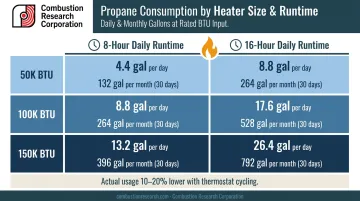
Based on theoretical consumption; actual usage 10–20% lower depending on efficiency and thermostat cycling
Runtime schedule is a major cost lever. A 100,000 BTU heater on a 16-hour daily schedule consumes double the propane of the same unit running 8 hours — a straightforward calculation that often gets skipped in early budget planning.
Seasonal Cost Estimation
Those daily figures compound quickly across a heating season. For facilities in colder climates, peak runtime typically runs October through March, with lighter use in fall and spring as temperatures moderate.
Sample scenario: A 100,000 BTU heater running 10 hours/day for 5 peak months (150 days):
- Daily consumption: ~1.09 gal/hr × 10 hrs = 10.9 gallons
- Seasonal total: 10.9 × 150 = ~1,635 gallons
- Estimated seasonal cost at $2.674/gallon (EIA national residential average, March 2026): ~$4,370
Note: Commercial delivered propane prices vary by region and contract. The EIA figure is a residential national benchmark — actual costs may differ.
Tank Sizing Implications
Daily consumption figures translate directly into tank sizing decisions. One critical detail: use usable capacity, not nameplate volume. A 500-gallon tank holds roughly 400 usable gallons; a 1,000-gallon tank yields about 800.
| Tank Size | Usable Capacity | Runtime: 50,000 BTU (10 hr/day) | Runtime: 100,000 BTU (10 hr/day) |
|---|---|---|---|
| 100 lb cylinder | ~23 gal | ~4 days | ~2 days |
| 500 gal tank | ~400 gal | ~73 days | ~37 days |
| 1,000 gal tank | ~800 gal | ~145 days | ~73 days |
For industrial facilities running multiple heaters or high-BTU systems, a 500-gallon tank often covers a single heating season. Systems above 150,000 BTU, or multi-heater configurations, typically warrant a 1,000-gallon tank or a scheduled delivery contract.
Low-Intensity vs. High-Intensity Infrared Heaters
Not all propane infrared heaters consume fuel at the same rate for the same result. The heater type affects both how propane is burned and how effectively that heat reaches the target area.
| Attribute | Low-Intensity Tube Heaters | High-Intensity Ceramic/Plaque Heaters |
|---|---|---|
| Heating mechanism | Burner heats radiant tubes under reflectors | Open flame heats ceramic surface |
| Surface temperature | ~1,000°F | ~1,800°F |
| Typical BTU range | 40,000–250,000 BTU/hr | 30,000–200,000 BTU/hr |
| Efficiency range | 75–90%+ thermal efficiency | Up to ~81% radiant efficiency |
| Best application | Large warehouses, hangars, high-bay spaces | Spot heating, shorter mounting heights |
| Venting | Vented or unvented options | Often unvented |
| Maintenance needs | Lower — no filters, minimal wear components | Higher — ceramic elements degrade over time |
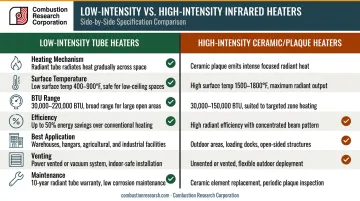
Low-intensity tube heaters distribute heat evenly across large floor areas at lower surface temperatures. This even distribution reduces the overheating of specific zones (a common problem with high-intensity units) and eliminates the air stratification that forces forced-air systems to run longer.
That design logic is built into CRC's Reflect-O-Ray and Omega II systems. The True Dual Modulating operation in the Omega II 9K Series goes further, dropping to low-heat during mild conditions rather than cycling on and off at full output — delivering 30–50% energy savings over conventional heating systems across both new construction and retrofit applications.
How to Calculate Your Facility's Propane Needs
Accurate propane budgeting starts with a proper heating load calculation. Over-specifying wastes capital on equipment and fuel; under-specifying leads to chronic fuel overspend and inadequate comfort.
Load Calculation Inputs
A proper calculation requires:
- Floor area (sq. ft.)
- Ceiling height — critical in high-bay spaces; heat loss increases substantially with volume
- Insulation level — walls, roof, and floor construction U-values
- Infiltration rate — number and frequency of door openings, air sealing quality
- Geographic climate zone — outdoor design day temperature (ASHRAE 99% or 99.6% heating dry-bulb)
- Target indoor temperature — typically 60–65°F for warehouses, higher for occupied workspaces
Climate data alone shows the range: Minneapolis–St. Paul has a 99.6% heating design temperature of -23.6°C (-10.5°F), while Detroit's equivalent is -16.6°C (2°F) — a difference that meaningfully changes total seasonal fuel consumption for the same building.
Simplified Example
Scenario: 10,000 sq. ft. warehouse, 20-ft ceilings, minimal insulation, design day of 0°F, target indoor temperature 60°F.
- Temperature differential: 60°F indoor – 0°F outdoor = 60°F ΔT
- Envelope heat loss: Apply U-factors for walls, roof, and floor across total surface area
- Infiltration load: Account for dock doors, personnel doors, and air leakage
- Total BTU load: A minimally insulated high-bay warehouse of this size could easily require 250,000–400,000 BTU/hr at design conditions — which might mean 2–3 heaters in the 100,000–150,000 BTU range
- Annual propane: At 10 hours/day for 150 peak-season days, this facility would consume roughly 2,400–3,900 gallons per season
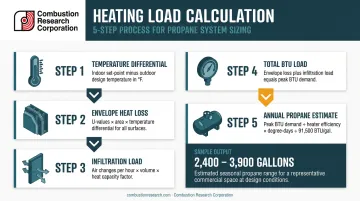
These figures illustrate why generic BTU-per-square-foot estimates often fail. The same floor area in a well-insulated, low-ceiling facility might require 40% fewer BTUs at design day — and sizing errors made during planning directly translate into budget overruns that repeat every heating season.
Common Sizing Mistakes to Avoid
- Sizing on floor area alone ignores ceiling height and infiltration — the most common cause of under-budgeting in high-bay spaces
- Applying patio or residential benchmarks to industrial facilities — BTU ranges and operating profiles are fundamentally different categories
- Skipping engineering support during the specification phase — a heat loss calculation at the design stage costs far less than years of oversized or undersized equipment
Combustion Research Corporation provides engineering support throughout the specification and design process for both new construction and retrofit projects, including heat loss calculations, to help facilities right-size systems and avoid overspending and fuel waste.
Frequently Asked Questions
How much propane does a 30,000 BTU infrared heater use?
At full input, a 30,000 BTU heater consumes approximately 0.33 gallons per hour (30,000 ÷ 91,452). Real-world usage is slightly lower (typically 0.28–0.30 gal/hr) due to thermostat cycling and efficiency losses. Over an 8-hour day, that's roughly 2.3–2.6 gallons.
How much does it cost to run an infrared heater for 1 hour?
Multiply gallons per hour by your delivered propane price. Using the EIA national benchmark of $2.674/gallon: a 30,000 BTU heater costs roughly $0.88/hr; a 100,000 BTU heater runs about $2.92/hr. Commercial delivered prices vary, so confirm your actual contract rate for accurate budgeting.
How long will 500 gallons of propane last in the winter?
It depends on your heater's BTU load and daily runtime. A 100,000 BTU heater running 10 hours/day burns roughly 10.9 gallons daily — about 37 days from the 400 usable gallons in a 500-gallon tank. For a reliable seasonal estimate, run a full load calculation against your actual operating schedule.
How do I calculate propane consumption for my infrared heater?
Use the formula: BTU rating ÷ 91,452 = gallons per hour. Multiply by daily operating hours for daily consumption, then by 30 for monthly totals. For seasonal estimates, factor in reduced runtime during shoulder months and adjust for your heater's actual efficiency rating.
Are propane infrared tube heaters more fuel-efficient than forced-air heaters?
Yes. Infrared tube heaters heat objects and occupants directly rather than warming air that escapes through openings and infiltration points. ASHRAE Journal research found infrared heaters used 33–50% less energy than unit heaters in comparable building tests — a meaningful difference in large-volume industrial and commercial spaces.