In a 30-foot-ceiling warehouse, the wrong mounting decision can mean cold spots across the work floor, blocked forklift lanes, or heat pooling near the roof where nobody benefits. These aren't minor comfort issues — they translate directly into energy waste and operational disruption.
This article breaks down how each configuration performs, where each excels, and how to choose between them based on your facility's actual layout.
Key Takeaways
- Ceiling-mounted infrared heaters deliver broader, more uniform heat distribution and are generally more efficient in open industrial spaces with high ceilings
- Wall-mounted units work best for targeted zone heating in spaces with lower ceilings or individual workstations
- Ceiling mounting preserves floor space, cuts stratification losses, and reduces forklift contact risks
- Key decision variables: ceiling height, floor plan dimensions, and desired coverage scope (full-bay vs. zone)
- In most warehouses, hangars, and service bays, ceiling-mounted low-intensity tube heaters are the preferred choice
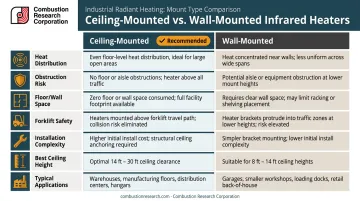
Ceiling vs Wall Mounted Infrared Heaters: Quick Comparison
The right mounting position depends on your facility's ceiling height, floor activity, and layout. Here's how the two configurations compare across the factors that matter most.
| Factor | Ceiling-Mounted | Wall-Mounted |
|---|---|---|
| Heat distribution | Broad downward coverage across floor area | Directional, horizontal projection |
| Obstruction risk | Minimal — heaters above all equipment | Higher — blocked by racking, columns, machinery |
| Floor/wall space | Fully preserved | Occupies wall real estate |
| Forklift safety | Out of traffic path entirely | Lower position increases contact risk |
| Installation complexity | More complex in retrofit; ideal for new construction | Simpler in smaller enclosed spaces |
| Best ceiling height | 14 ft and above | Under 14 ft |
| Typical applications | Warehouses, hangars, dealerships, wash bays | Service garages, bump shops, greenhouses |
What Are Ceiling-Mounted Infrared Heaters?
Ceiling-mounted infrared heaters are radiant units suspended from or attached to the overhead structure. They emit infrared radiation downward, warming occupants, equipment, and floor surfaces directly. The air itself is largely irrelevant to the heat transfer process.
Why High-Bay Efficiency Depends on Ceiling Mounting
The core efficiency advantage is physics. In any building with ceilings above 14 feet, warm air from convective systems rises and stratifies. ACEEE case studies found that conventional forced-air systems in high-ceiling industrial facilities stratify at roughly 5°F per 10 feet of height. That means a 30-foot warehouse can have a 15°F difference between floor and ceiling. Workers sit in the cold zone while heated air accumulates where it helps no one.
Ceiling-mounted infrared heaters sidestep this entirely. Because radiation travels in straight lines from the heater to the surface below, the occupied zone receives heat regardless of ceiling height. There's no intermediate air mass to lose energy into.
Industrial Configurations
For large open-span facilities, two configurations dominate:
- Low-intensity gas-fired tube heaters — suspended linear systems running the length of a bay, ideal for warehouses, hangars, and dealerships
- High-intensity radiant units — shorter mounting heights, better suited to lower bays or spot heating tasks
Combustion Research Corporation's Omega II and Reflect-O-Ray product lines cover both power-vented and vacuum-vented ceiling-mounted configurations, with BTU inputs from 30,000 to 220,000 BTU/hr.
The Reflect-O-Ray vacuum systems are particularly effective in aircraft hangars and large warehouses where bay doors cycle frequently. The negative-pressure design means any tube breach draws ambient air inward rather than pushing exhaust gases into the occupied space.
Where Ceiling Mounting Is the Standard
Ceiling-mounted infrared heaters are the default specification for:
- Large warehouses and distribution centers
- Aircraft hangars (minimum 10 ft clearance above the highest wing surface)
- Auto dealerships and vehicle service bays
- Car and truck wash bays
- Shipping and receiving docks
- Ice arenas and natatoriums
- Pole barns and agricultural facilities with significant ceiling height
BLS data recorded 9,050 nonfatal forklift injuries in 2017 alone. Keeping heating infrastructure out of forklift traffic paths entirely eliminates that category of equipment contact risk.
What Are Wall-Mounted Infrared Heaters?
Wall-mounted infrared heaters are fixed to vertical surfaces and project heat horizontally across a space. To improve dispersion and reduce blockage by equipment, they're typically installed high on the wall rather than at standard radiator height.
How Wall Mounting Creates Zonal Heat
The horizontal projection pattern makes wall-mounted units effective for defined work zones — a specific service bay, an entry vestibule, or a workstation near an exterior wall. The limitation is range. As distance from the wall increases, heat intensity drops off, and anything in the beam path — racking, columns, machinery — creates a shadow zone.
In large open-span buildings, this becomes a significant problem. A wall-mounted unit covering one side of a 60-foot-wide warehouse leaves the center floor cold. Supplemental units can address this, but the layout quickly becomes complicated and the cost-per-zone math gets harder to justify.
Installation Trade-offs
Wall mounting is genuinely simpler in smaller enclosed spaces. In a 10-foot-ceiling service garage, a wall-mounted unit can cover the space without the structural considerations that ceiling mounting requires.
That simplicity erodes in industrial settings, where wall space is rarely available. Competing for the same vertical surface in most facilities: storage shelving, electrical panels, access doors, and compressed air lines. The wall that would logically host a heater is often already occupied.
Where Wall Mounting Makes Sense
Wall-mounted infrared heaters are a practical choice for:
- Smaller service garages and residential garages
- Bump shops and enclosed oil and lube bays
- Greenhouses and agricultural brooders
- Single-zone spaces where spot heating at a defined workstation is the goal
- Areas with ceiling obstructions that prevent overhead installation
Ceiling vs Wall Mounted: Which Is More Efficient for Industrial Spaces?
The efficiency question comes down to five variables:
- Ceiling height
- Floor plan dimensions
- Obstruction profile
- Heat source type
- Whether you need full-bay coverage or zone-specific warmth
The Stratification Argument
For facilities with ceilings above 14 feet, ceiling-mounted infrared wins on physics alone. The ACEEE hangar case study is instructive: in a facility with 40–45 foot ceilings, infrared heaters mounted at 30 feet produced near-identical temperatures at both the 5-foot and 24-foot measurement points. The radiant system eliminated the temperature gradient that convective heating creates.
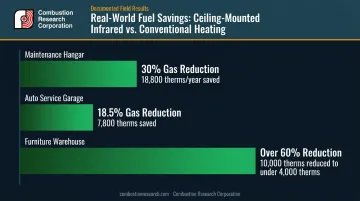
That same study documented a 30% reduction in annual gas consumption (18,800 therms/year) in the maintenance hangar after switching to ceiling-mounted infrared. An auto service garage in the same research showed an 18.5% gas reduction (7,800 therms). A furniture warehouse with 17-foot ceilings dropped from 10,000 therms to under 4,000 therms annually — a reduction of more than 60% in that specific case.
According to AHRI/IRSC, gas-fired infrared heaters deliver an average 30% fuel savings over conventional heating systems. CRC's internal positioning cites 30–50% over conventional systems, with the upper range reflecting facilities with particularly severe stratification losses or frequent door cycling.
Coverage Pattern and Obstruction
Ceiling-mounted tube heaters can be laid out to cover the entire floor plane with overlapping radiant fields. Manufacturer layout guides recommend combination layouts for spaces wider than 100 feet, placing 10–20% of total heat capacity near the center. This gives consistent floor-level coverage without cold zones.
Wall-mounted units face a narrower effective geometry. Standard installation parameters call for positioning wall-mounted units 5–12 feet from the wall, with no more than 20 feet between units — constraints that work in small enclosed spaces but require significantly more units to cover a large floor area.
Situational Recommendations
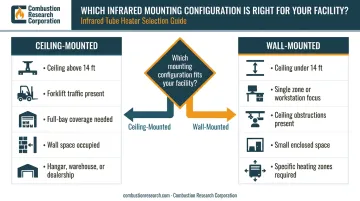
Those coverage geometry differences drive the recommendations below. Choose ceiling-mounted infrared when:
- Ceiling height exceeds 14 feet
- Active forklift or material-handling traffic occupies the floor
- Full-bay coverage across a large open floor plan is required
- Wall space is needed for storage, shelving, or operational access
- Facilities include aircraft hangars, large warehouses, or multi-bay dealerships
Choose wall-mounted infrared when:
- Ceiling height is under 12–14 feet
- A specific workstation or zone needs focused warmth
- Ceiling obstructions prevent overhead installation
- The space is smaller and enclosed, such as a single service bay
A Practical Scenario
A vehicle service dealership with five bays and 18-foot ceilings running gas-fired unit heaters is a common candidate for ceiling-mounted infrared conversion. The typical situation: uneven floor temperatures between bays, high gas bills during winter, and unit heaters on walls where technicians have struck them with lift equipment.
Switching to ceiling-mounted low-intensity tube heaters — such as CRC's Omega II or Reflect-O-Ray systems — addresses all three problems at once. The heaters move out of the equipment path, heat distribution becomes uniform across all five bays, and fuel consumption drops. CRC's engineering team can model heat distribution before installation begins, eliminating guesswork and post-installation adjustments.
Facilities evaluating this transition can request a free heating system specification from CRC's engineering team — the model output includes heater placement, BTU requirements, and projected fuel savings before any equipment is purchased.
Conclusion
Ceiling-mounted infrared heaters outperform wall-mounted configurations in large, open-span industrial environments because the physics work in their favor: unobstructed downward radiation, no stratification losses, preserved floor and wall clearance, and reduced equipment contact risk.
Wall-mounted units remain valid — they're appropriate for smaller, lower-ceiling spaces where targeted zone heating is the actual requirement. The mistake is applying them to problems they weren't designed to solve.
For warehouses, hangars, and service bays, ceiling height and floor layout are the two variables that matter most. Combustion Research Corporation's engineering team works through both new construction and retrofit projects, providing layout modeling and technical documentation to confirm the right configuration before equipment is specified.
Frequently Asked Questions
Are infrared ceiling heaters any good?
Ceiling-mounted infrared heaters are highly effective in industrial and large commercial spaces. They deliver unobstructed downward radiant heat with broad coverage and eliminate energy losses from air stratification — a common problem with convective systems in high-bay buildings.
What is the most efficient mounting position for infrared heaters in a warehouse?
Ceiling mounting is more efficient for warehouses because the unobstructed downward heat path reduces energy waste, keeps floors and walls operationally clear, and delivers even coverage across large open floor areas — particularly in buildings with ceilings above 14 feet.
How high can ceiling-mounted infrared heaters be installed and still be effective?
Low-intensity infrared tube heaters can operate effectively at heights up to 30–45 feet, depending on model and BTU output. The ACEEE hangar case documented effective performance at 30-foot mounting height in a facility with 40–45-foot ceilings. Correct placement is output-dependent, so engineering review during specification is strongly recommended.
Can infrared heaters be wall-mounted in industrial spaces?
Wall mounting is practical in smaller or lower-ceiling industrial spaces like single-bay garages and enclosed service areas. In larger open-bay environments, ceiling mounting outperforms wall mounting for coverage uniformity and operational safety.
Do ceiling-mounted infrared heaters interfere with overhead equipment or sprinkler systems?
Proper engineering and clearance specifications are required for compatibility with overhead cranes, sprinkler heads, and ventilation. CRC offers both vacuum-vented and power-vented configurations with engineering support to address facility-specific overhead constraints, including shared exhaust manifolds that reduce roof penetration requirements.
How much can ceiling-mounted infrared heating save compared to conventional forced-air heating?
AHRI/IRSC data supports an average 30% fuel savings over conventional heating, with ACEEE case studies documenting reductions from 18.5% in auto garages to over 60% in some warehouse applications. Our systems are engineered to deliver 30–50% savings, with the actual range depending on facility-specific factors like ceiling height and door cycling frequency.