Introduction
Heating large commercial spaces is expensive—and the problem compounds in buildings with high ceilings, loading dock doors that cycle constantly, or wide-open floor plans. Forced-air systems weren't designed for these conditions. They heat air that immediately stratifies toward the ceiling, leaving workers cold at floor level while the thermostat runs nonstop trying to compensate.
Radiant heating addresses this directly by warming objects and people rather than air—but the efficiency story isn't as simple as swapping one system for another. The gains are real and well-documented in industrial applications, yet they depend heavily on system type, building design, and how the system is specified and controlled.
This article covers the measurable efficiency advantages of gas-fired infrared tube heaters in commercial and industrial spaces, the honest trade-offs, and the conditions where radiant heating delivers its greatest efficiency gains.
Key Takeaways
- Radiant heating delivers infrared energy directly to people and surfaces, bypassing the air and its duct losses entirely
- Gas-fired infrared tube heaters can reduce heating energy costs by 30–50% in large commercial and industrial facilities
- Efficiency advantages include zero duct losses, zone-targeted heating, and comfort at lower ambient temperatures
- Real cons: higher upfront cost, insulation dependency, and electric systems that aren't cost-effective at large scale
- Payback periods in published case studies range from 2–5 years depending on facility size and baseline fuel use
What Is Radiant Heating and How Does It Work?
Radiant heating transfers heat via infrared radiation—directly to objects, surfaces, and people in a space rather than heating the surrounding air first. The physics are the same as standing in sunlight on a cold day: the air temperature hasn't changed, but you feel warm.
In industrial and commercial settings, two system types come up most often:
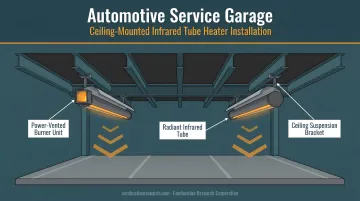
- Gas-fired infrared tube heaters (low-intensity): Ceiling-mounted, burner-driven systems where combustion gases travel through a long metal tube, heating it to the point of emitting infrared radiation. Best suited for warehouses, aircraft hangars, automotive service facilities, and other large-volume spaces. This is where the efficiency gains are most significant.
- Electric radiant systems: Easier to install, but operating costs in large spaces are significantly higher than gas-fired alternatives. Better suited to residential garages, patios, and spot-heating applications.
The rest of this article focuses on gas-fired infrared tube systems, where the efficiency math is most favorable for large facilities.
Combustion Research Corporation manufactures several gas-fired lines for these applications, including the Omega II (power-vented), Reflect-O-Ray (vacuum-vented), and Synergy (high-intensity) series, with BTU inputs ranging from 30K to 220K depending on facility requirements.
Key Advantages of Radiant Heating
Facility managers evaluating radiant heating typically measure success across four metrics: energy cost per square foot, heating consistency, maintenance frequency, and worker comfort. Gas-fired infrared tube heaters perform well on all four — here's why.
No Duct Losses: Heat Goes Directly Where It's Needed
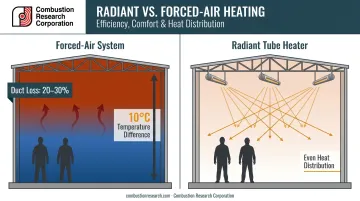
In a forced-air system, a meaningful percentage of heating energy is lost before it ever reaches the occupied zone. ENERGY STAR estimates that 20–30% of air moving through a typical duct system is lost through leaks and poorly connected ducts. In commercial and institutional buildings, a Center for Energy and Environment study found duct leakage ranging from 0% to 29% of flow rates—and that's before accounting for heat stratification.
Gas-fired infrared tube heaters eliminate this loss category entirely. There's no ductwork. Infrared energy travels from the tube to the floor, equipment, and occupants directly.
The stratification problem worsens the duct loss problem in high-ceiling spaces. Research on industrial warehouses found temperature differences of up to 10°C between floor and ceiling—meaning a forced-air system maintaining 65°F at thermostat height may be delivering only marginal warmth at floor level where workers actually are. Infrared tube heaters bypass this entirely by heating at occupant level rather than fighting the physics of warm air rising.
When this advantage matters most:
- Buildings with ceilings above 14–16 feet
- Facilities with frequent door cycling (loading docks, service bays, hangars)
- Cold-climate operations where heating runs near-continuously
KPIs affected: Monthly energy spend, BTU efficiency ratio, heating cost per occupied square foot
Zone Heating: Pay to Heat Where People Work
A centralized forced-air system heats the entire building volume — regardless of whether workers are using all of it. In a warehouse where activity concentrates in a few bays, or an automotive facility where only certain service bays run at once, that's wasted fuel on every shift.
Ceiling-mounted infrared tube heaters can be zoned to match actual occupancy. Each zone operates independently, so facility managers heat only what's in use — and only when it's in use.
When this advantage matters most:
- Large warehouses with variable occupancy patterns
- Mixed-use facilities with distinct work zones (shipping docks vs. office areas)
- Seasonal operations or shift-based facilities where occupancy drops significantly during off hours
KPIs affected: Energy waste reduction, zone-level operating cost, thermostat scheduling flexibility
Comfort at Lower Ambient Temperatures
Radiant systems warm surfaces and people directly, which raises perceived comfort without raising the thermostat. Research on gas-fired direct radiant heaters in industrial workstations found that equivalent thermal comfort can be maintained at 2–3°C (roughly 3.6–5.4°F) lower indoor temperature compared to conventional heating systems.
Each degree reduction in set-point temperature means less run time and lower fuel spend — a difference that adds up across an entire heating season.
Radiant heating also doesn't move air — a meaningful advantage in facilities where airborne dust or particulate circulation affects product quality or safety. In automotive finishing environments, food-adjacent facilities, animal confinement operations, and natatoriums, that distinction carries operational and regulatory weight.
When this advantage matters most:
- Facilities where air quality or contamination affects product or safety
- High-occupancy floor-level environments (assembly lines, animal confinement)
- Automotive finishing environments where air movement affects paint or coating quality
The Honest Cons: Where Radiant Heating Has Limitations
Radiant heating's efficiency advantages are real, but they're conditional. Here's where the trade-offs actually live:
Higher Upfront Installation Cost
Well-engineered ceiling-mounted infrared tube systems carry a higher initial capital cost than conventional forced-air units. An ACEEE case study of an automotive service garage retrofit (~3,670 sq ft) came in at $40,000, with annual savings of more than $8,300 and a payback under five years. The ROI case is strong, but the capital requirement is real and needs accurate energy modeling to justify.
Slower Warm-Up for Hydronic Systems
This con is often misapplied to all radiant systems. Hydronic (water-based) radiant floor systems embedded in a concrete slab can take hours to reach operating temperature. The DOE notes these systems are sometimes "charged" during overnight off-peak windows to manage this lag.
Gas-fired infrared tube heaters respond much faster. CRC's Synergy high-intensity line, for example, reaches maximum operating temperature in under a minute. Know which system type you're evaluating before accepting warm-up concerns as a relevant objection.
Efficiency Depends on Building Insulation
Radiant heating doesn't overcome a poor building envelope. If heat escapes through walls, roof, or floor slab faster than the system can deliver it, run time increases and efficiency gains shrink. Adequate insulation is a prerequisite.
Electric Radiant Is Expensive to Operate at Scale
Electric radiant systems are easier to install but carry higher per-unit operating costs in large commercial or industrial spaces. The 30–50% energy cost advantage documented for gas-fired infrared systems does not apply to electric resistance heating in large facilities. For any significant-scale industrial application, gas-fired infrared is the right comparison, not electric.
Retrofit Complexity
Adding radiant heating to an existing facility mid-operation takes more planning than incorporating it during new construction. This is a timing issue, not a system defect, but worth factoring into project scheduling decisions.
What Happens When Facilities Stick with Conventional Heating
Forced-air systems in high-ceiling industrial spaces have a compounding cost problem:
- Warm air rises immediately, stratifying near the ceiling where no one works
- The thermostat reads cold at occupant level and calls for more heat
- The system runs longer—and duct losses continue throughout
- Workers remain uncomfortable, leading to thermostat creep and even higher energy spend
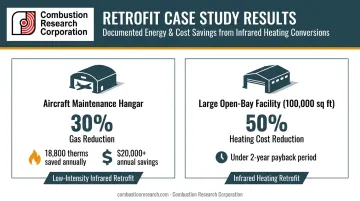
The ACEEE case data illustrates the real-world gap. An aircraft maintenance hangar retrofit from gas-fired unit heaters to low-intensity infrared reduced gas consumption by 30%, saving more than 18,800 therms per year and more than $20,000 annually. A U.S. Naval Facilities Engineering technical data sheet found that retrofitting large open-bay facilities like aircraft hangars could save up to 50% of total heating costs, with a payback period of under two years for a 100,000 sq ft, 40-ft-ceiling building.
Those savings figures don't include the recurring costs that conventional systems layer on top. Facilities regularly absorb expenses that rarely show up in the initial comparison:
- Filter replacement and periodic duct sealing
- Belt and fan servicing on air-handling units
- Ongoing difficulty retrofitting zoned control into a centralized architecture
These costs accumulate in the background. Most facilities don't fully account for them until a formal energy audit puts a number on the total.
How to Get Maximum Efficiency from Radiant Heating
Radiant heating reaches peak efficiency when the system is properly designed for the actual space. Ceiling height, occupancy patterns, insulation quality, and zone layout all feed directly into how a system should be specified. Undersized systems run continuously without maintaining comfort; oversized systems cycle inefficiently and cost more upfront than necessary.
Combustion Research Corporation provides engineering support throughout the specification process—for both new construction and retrofit projects—including heat loss calculations and system design tailored to the facility's actual operating conditions.
The highest-leverage operational controls:
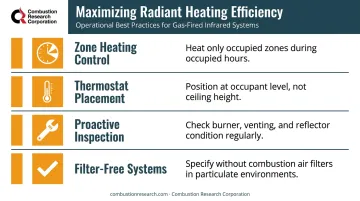
- Heat only occupied zones during occupied hours — always-on or poorly zoned systems erase a significant portion of the efficiency advantage
- Place thermostats at occupant level, not ceiling height; radiant systems maintain comfort at lower ambient temperatures, so aggressive set-point reduction is achievable without sacrificing worker comfort
- Inspect regularly rather than reactively — checking burner performance, venting integrity, and reflector condition keeps efficiency ratings intact across the full service life
- Specify systems without combustion air filters where possible; in high-particulate environments, filters are the most common avoidable maintenance trigger
CRC's Omega II and Reflect-O-Ray lines are engineered without combustion air filters by design, making them well-suited for dusty industrial and agricultural settings.
Conclusion
Gas-fired infrared tube heaters are more energy efficient than forced-air systems in commercial and industrial applications—specifically in large-volume, high-ceiling spaces where air stratification, duct losses, and uncontrolled zoning drain conventional systems of their effectiveness. Published case studies and government technical guidance support 30% savings in documented industrial retrofits and up to 50% in large open-bay conversions.
The cons are real but manageable. Higher upfront cost is offset by documented payback periods in the two-to-five-year range. Retrofit complexity is a planning consideration, not a system limitation. And the efficiency advantage cited for radiant heating applies to gas-fired systems—electric radiant is the wrong comparison for large-scale industrial heating decisions.
Efficiency returns don't arrive automatically. They compound when systems are properly specified, zones are actively managed, and inspection is proactive rather than reactive. Combustion Research Corporation provides engineering support through the specification process for both new construction and retrofit projects—because a well-specified system is where the long-term savings actually begin.
Frequently Asked Questions
Is radiant heating energy efficient?
Yes—particularly gas-fired infrared tube systems in commercial and industrial spaces. These systems eliminate duct losses, deliver heat directly to occupants and surfaces, and maintain comfort at lower set-point temperatures. Published case studies and government data support energy cost reductions of 30–50% compared to conventional forced-air systems in large-volume facilities.
Should you buy a house with radiant heat?
Radiant heat is generally a positive feature: even, draft-free warmth, no dust circulation, and lower long-term operating costs than forced-air. Before making it part of your purchase decision, confirm the system type (hydronic or electric), its age, and whether recent maintenance records are available.
What are the main disadvantages of radiant heating?
The primary cons are higher upfront installation cost, efficiency dependence on building insulation quality, and slow warm-up times for hydronic floor systems. Electric radiant systems are also expensive to operate in large commercial spaces. The efficiency case for industrial applications rests specifically on gas-fired infrared, not electric resistance heating.
How does radiant heating compare to forced-air in energy use?
Radiant heating avoids duct losses that run 20–30% in residential systems and up to 29% in commercial buildings. It also maintains equivalent occupant comfort at 3–5°F lower set-point temperatures, and both factors reduce total fuel consumption compared to forced-air.
Is radiant heating effective in large industrial or commercial spaces?
Gas-fired infrared tube heaters are well-suited for large-volume spaces like warehouses, hangars, and service bays. They heat at occupant level rather than fighting air stratification, ceiling-mounted configurations preserve floor space, and they reduce equipment contact risks in facilities with forklifts or material-handling machinery.
How long does it take for radiant heating to pay for itself?
Published third-party examples show payback periods from roughly two years (100,000 sq ft open-bay building, per U.S. Naval Facilities Engineering data) to under five years (auto service garage retrofit, per ACEEE). Actual payback depends on baseline fuel use, ceiling height, local energy rates, operating hours, and system design quality.