All radiant systems share one core advantage: they transfer heat directly to objects and people rather than conditioning air as an intermediary. That single difference eliminates what the U.S. Department of Energy identifies as one of the biggest sources of residential heating waste — duct systems that lose 25 to 40 percent of heating energy before it reaches the occupied space.
This article covers the physics behind why radiant heat works, how it stacks up against conventional systems, what the different system types actually deliver in practice, and where the technology genuinely shines versus where it's oversold.
Key Takeaways
- Radiant heat transfers energy directly to surfaces and people, bypassing duct losses entirely
- Documented energy savings run 30–50% over conventional forced-air and unit heaters in commercial deployments
- Electric radiant produces no combustion losses at the point of use; actual operating cost depends on local electricity rates
- Hydronic systems work best for whole-home residential heating; gas-fired infrared tube heaters are the dominant choice for large commercial and industrial spaces
- Insulation quality, zone controls, and ceiling height all significantly affect real-world efficiency
How Radiant Heat Works and Why It's Inherently Efficient
The Physics Behind Direct Heat Transfer
Radiant systems emit electromagnetic waves that warm objects and people in their path without requiring air movement — the same mechanism that makes sunlight feel warm on a cold day even when the air temperature is low. No duct, no fan, no air volume to condition first.
This matters because conventional forced-air systems heat air as an intermediary. That air must travel through ducts, rise through a room, and somehow reach occupants at floor level — and at every step, energy leaks out. The DOE's estimate of 25–40% duct energy loss in residential systems reflects just how much can be wasted before heat does any useful work.
The Stratification Problem Radiant Solves
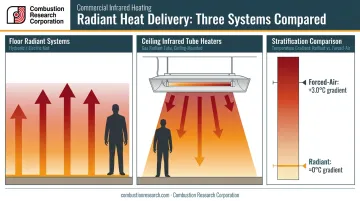
Heat stratification is a fundamental problem in any space with volume. Warm air rises. In a forced-air heated room, the warmest air sits at the ceiling — the least useful location for occupant comfort. A warehouse worker or service bay technician ends up standing in the coldest air in the building.
Radiant systems address this differently:
- Floor-based systems (hydronic, electric mats) deliver warmth from below, keeping heat in the occupied zone
- Ceiling-mounted systems (gas-fired infrared tubes, high-intensity ceramic units) radiate downward directly onto people, equipment, and floor surfaces
- Measured stratification gradients in forced-air warehouses reach up to 3.0°C — radiant systems reduce this to near-zero in the occupied zone
Lower Operating Temperatures, Same Comfort
Because radiant heat warms people directly rather than through air temperature, the same perceived comfort level is achievable at lower thermostat settings. ASHRAE's thermal comfort standard accounts for both air temperature and mean radiant temperature — for still-air conditions, each contributes roughly equally to perceived warmth.
This means a space can feel comfortable at a lower air temperature reading when surfaces are radiantly heated, reducing the energy demand on the heat source.
Radiant Heat vs. Conventional Heating: An Efficiency Comparison
How the Numbers Compare
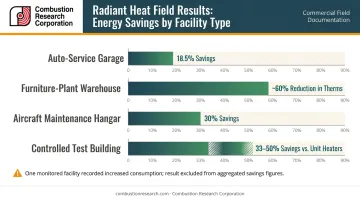
The efficiency advantage of radiant over forced-air is real, but the magnitude varies substantially by application. The strongest controlled test result in the research literature: infrared tube heaters used approximately 50% less energy than unit heaters in a 20-foot test building, with a higher-insulation variant reducing that advantage to about 33% (summarized in ASHRAE Journal, 2007, citing 2002 controlled testing).
Field results are more variable. Documented case studies include:
- Auto-service garage: ~18.5% savings after replacing gas unit heaters with infrared (7,800 therms/year saved from a 42,000 therm baseline)
- Furniture-plant warehouse: Gas use fell from over 10,000 to under 4,000 therms/year — though setpoint changes and night setback contributed alongside the system change
- Aircraft maintenance hangar: 30% savings from a redesigned infrared system — though this was an infrared-to-infrared comparison, not radiant vs. forced-air
- One facility saw consumption increase after a poorly designed infrared conversion — demonstrating that system layout and zone coverage can erase any efficiency gains before they start
Across these cases, outcomes ranged from a net consumption increase to roughly 50% savings — and the difference came down to system design, insulation, controls, and what was being replaced.
Side-by-Side Comparison
The table below shows how those variables translate across system types — where radiant pulls ahead, where forced-air holds its own, and where electric baseboard consistently falls short.
| Metric | Radiant Heat | Forced-Air | Electric Baseboard |
|---|---|---|---|
| Distribution losses | None (no ducts) | 25–40% (DOE estimate) | Minimal, but poor distribution |
| Heat stratification | Low (heat delivered at occupant level) | High (warm air rises) | Moderate |
| Operating temperature | Lower surface temps, same comfort | Higher setpoints required | Very high surface temps |
| Air quality impact | No air circulation; reduced dust | Circulates dust and particulates | No air circulation |
| Best application | Commercial/industrial, whole-home hydronic | Standard residential and light commercial | Supplemental or zone heating |
Electric Baseboard: A Useful Comparison Point
Electric baseboard units convert electricity to heat at 100% efficiency at the point of use — the same as electric radiant. That's where the similarity ends. Several structural disadvantages undercut their real-world performance:
- Run along exterior walls directly below windows, fighting the coldest surfaces in the room
- Require very high surface temperatures to compensate for poor heat distribution
- Deliver heat low in the space where it rises away from occupants before doing useful work
The result: equal input efficiency, substantially worse output per dollar spent compared to a well-designed radiant system.
Types of Radiant Heat and Their Efficiency Levels
Electric Radiant Heat
Electric radiant systems — cables or mats embedded beneath flooring — convert incoming electricity to heat with no combustion losses at the point of use. The DOE confirms electric resistance heating is 100% efficient at the point of use, though that figure doesn't account for generation losses upstream.
The practical limitation is operating cost. Electricity rates vary significantly by region, and in most U.S. markets, electric heat is more expensive to operate per BTU than gas. Electric radiant makes the most sense for:
- Bathroom floor warming
- Supplemental zone heating in specific rooms
- Commercial spaces without gas infrastructure (where Combustion Research Corporation's Solaira Alpha commercial electric infrared fills this role)
For whole-building primary heat in most U.S. markets, the operating cost math generally favors gas-fired systems.
Hydronic (Water-Based) Radiant Heat
Hydronic systems circulate hot water through tubing beneath floors, using a boiler as the heat source. Water retains heat well, and systems can operate at lower water temperatures — especially with modern condensing boilers — keeping gas-fired operating costs below electric alternatives in most U.S. markets.
ENERGY STAR commercial boilers require ≥94% thermal efficiency, and condensing-level efficiency (≥90% Et) is now required for specified large new-construction boiler systems under ASHRAE 90.1-2022. These are heat-source benchmarks — whole-system efficiency also includes distribution and floor assembly losses — but the underlying heat source is highly efficient.
Hydronic radiant suits lower-ceiling residential and light-commercial applications well. In large commercial or industrial facilities, gas-fired radiant tube heaters typically outperform hydronic on installation cost, zoning flexibility, and response time.
Infrared Tube Heaters (Gas-Fired)
Gas-fired infrared tube heaters are the dominant technology for commercial and industrial radiant heating. They emit long-wave infrared radiation that warms objects and people directly without heating the surrounding air volume first.
This approach is well-suited to large, open, or high-ceiling spaces for three reasons:
- Heat is delivered to the occupied zone without conditioning the full air volume
- No ducts or complex distribution loops to lose heat through
- Systems can be zoned or spot-targeted to heat only where workers or equipment are present
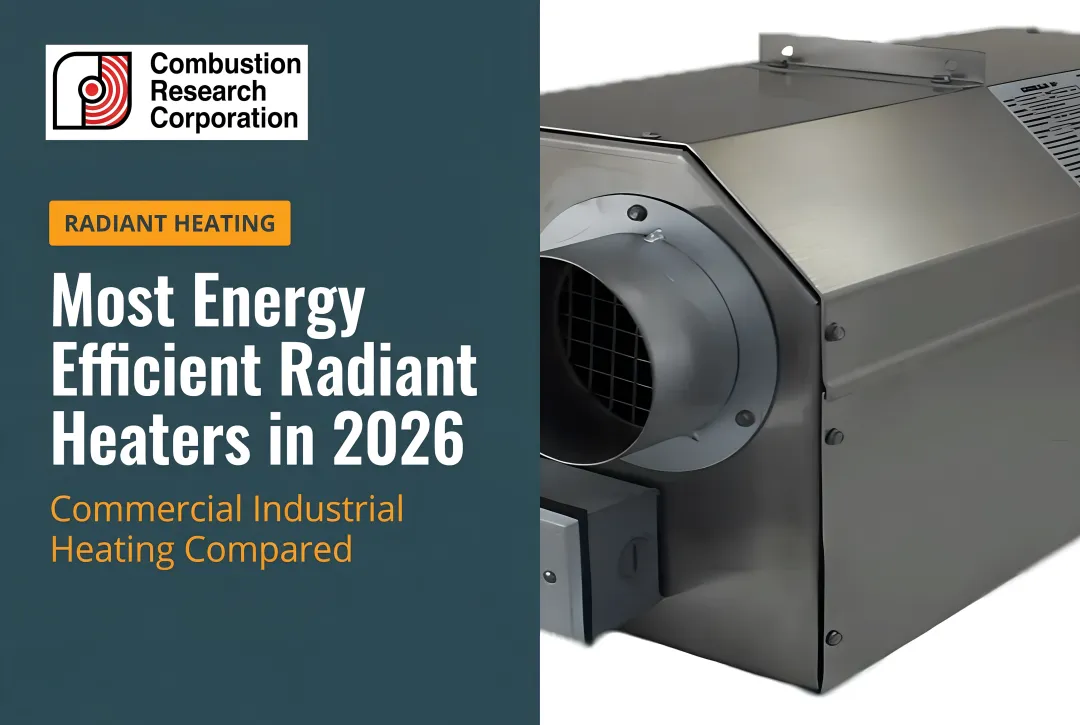
Combustion Research Corporation's low-intensity infrared tube heaters — the Reflect-O-Ray vacuum systems and Omega II power-vented systems — are built for these environments: warehouses, aircraft hangars, auto dealership service bays, and agricultural facilities. Across commercial deployments, CRC documents 30–50% energy savings compared to conventional forced-air systems.
Air-Based Radiant Systems
Air-heated radiant floors circulate warm air through channels beneath the floor. The DOE characterizes these as not cost-effective for residential applications because air holds heat poorly — distribution losses undercut the radiant delivery advantage. For commercial facilities with access to gas, hydronic or gas-fired radiant tube systems are almost always the better choice on both efficiency and operating cost.
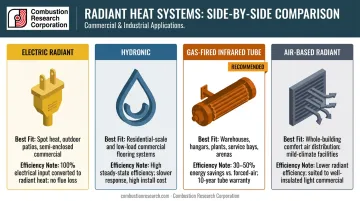
Quick Comparison: Radiant Heat Types by Application
| System Type | Best Fit | Efficiency Highlight |
|---|---|---|
| Electric radiant | Supplemental/zone heating, no-gas facilities | 100% efficient at point of use |
| Hydronic | Residential, light commercial, low-ceiling spaces | ≥94% boiler efficiency (ENERGY STAR) |
| Gas-fired infrared tube | Warehouses, hangars, industrial facilities | 30–50% savings vs. forced-air |
| Air-based radiant | Rarely recommended | Poor heat retention; high distribution losses |
Key Factors That Affect Radiant Heat Efficiency
Three variables determine whether a radiant system delivers on its efficiency potential in practice.
Insulation
Radiant efficiency depends on heat moving toward the occupied space, not away from it. Without adequate insulation below and around the heated surface, energy migrates into the subfloor, ground, or surrounding structure.
A DOE building energy codes draft proposed R-3.5 insulation on the non-radiant surface of interior radiant panels — the underlying principle is that every BTU heading the wrong direction is a BTU wasted. In industrial settings, roof insulation and building envelope quality matter equally.
Thermostat and Zone Control
A radiant system running continuously or heating unoccupied zones throws away the efficiency advantage the technology offers. Modeled EnergyPlus analysis across commercial building types found that wider thermostat deadbands combined with night setback contributed 7.7% site-energy savings in commercial buildings — meaningful, though results are design-specific.
CRC's dual-stage systems (Synergy Dual Stage, Omega II 9K Series, Reflect-O-Ray 4DI) support two-stage modulating operation that reduces output during partial-load conditions rather than cycling fully on or off, improving real-world efficiency.
Space Characteristics
Ceiling height, air exchange rate, and door-cycling frequency all affect outcomes. Radiant heat has a structural advantage in spaces with poor air retention — loading docks, hangars, facilities with large door openings — because it heats objects rather than air.
When a bay door opens and warm air escapes, the thermal mass of the floor and equipment re-radiates heat back to the occupied zone almost immediately. Forced-air systems must reheat the entire air volume from scratch with each cycle.
Is Radiant Heat Efficient for Large Commercial and Industrial Spaces?
Conventional forced-air heating becomes dramatically less practical as building volume increases. In a high-bay warehouse or aircraft hangar with 20–30 foot ceilings, warm air must travel far above the occupied zone before it can do anything useful — and it escapes entirely every time an oversized door opens. The air volume being conditioned is often many times larger than the volume where workers actually operate.
ASHRAE 90.1 states directly that "radiant heating shall be used when heating is required for unenclosed spaces" — with a limited exception for loading docks using air curtains. That language reflects what decades of controlled testing and field data have confirmed: radiant heating is the technically appropriate solution for these environments.
Why Ceiling-Mounted Infrared Works in These Environments
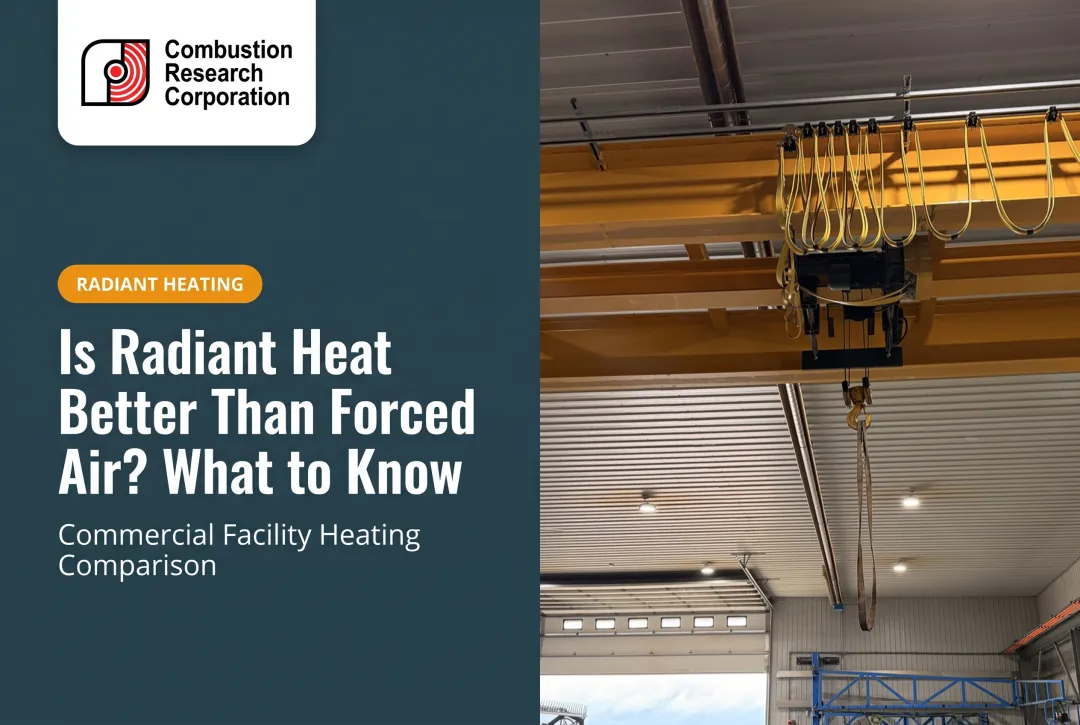
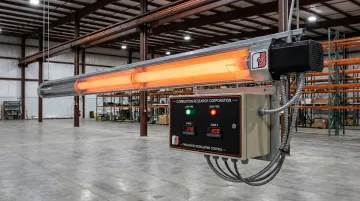
Ceiling-mounted infrared tube heaters solve the high-bay problem by radiating heat downward directly onto workers, floor surfaces, and equipment — bypassing the need to condition the air volume above. The key practical advantages:
- Door cycles don't reset the system — warm floor and equipment surfaces re-radiate heat immediately when doors close
- Zoning targets occupied areas only — a work bay heats differently from an adjacent storage zone, matching energy expenditure to actual need
- Floor space is preserved — no ground-level equipment for forklifts to strike
- Dust and pathogens stay settled — no forced-air circulation stirring up particulates
These advantages are particularly pronounced in facilities with ceilings 20 feet and above. Combustion Research Corporation's Reflect-O-Ray vacuum tube heaters are built for exactly this ceiling height range, providing optimized heat recovery during dock door cycles and reducing utility drop installations by up to two-thirds compared to competing systems.
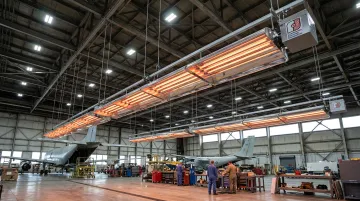
Across commercial deployments, CRC documents 30–50% energy cost reductions compared to conventional forced-air heating — a range supported by the controlled testing literature and consistent with field-reported outcomes across the industrial applications the company serves.
Frequently Asked Questions
Does radiant heat use a lot of electricity?
It depends on the system type. Electric radiant systems do use electricity, with operating costs varying by local rates and space size. Gas-fired infrared tube heaters and hydronic systems with gas boilers use electricity only for controls and ignition — making them far less electricity-intensive for primary heating. Dual-stage modulating controls reduce consumption further by matching output to actual load.
Can you heat an entire house with radiant heat?
Yes — whole-home radiant heating is common, particularly with hydronic systems connected to a high-efficiency gas boiler. The system must be properly sized for the home's heat loss, and well-insulated construction gets the most out of it. Hydronic radiant is rarely the right choice for whole-home heating via electric elements due to operating cost.
What is the most efficient type of radiant heat?
Hydronic systems with gas boilers are generally most efficient for residential whole-home use. Gas-fired infrared tube heaters are the most efficient choice for large commercial and industrial spaces — where conditioning the full air volume would be impractical and wasteful — and are the technology ASHRAE mandates for unenclosed spaces.
How much energy can radiant heat save compared to traditional heating?
Controlled testing found approximately 33–50% lower energy use versus unit heaters in a 20-foot test building. Field results vary widely by design, insulation, and controls — documented cases range from roughly 18% to over 60%, with at least one poorly designed installation resulting in increased consumption. Design quality matters as much as technology choice.
Is radiant heat efficient in spaces that aren't fully enclosed?
Radiant heat — particularly gas-fired infrared — is well-suited to partially open or frequently ventilated spaces. ASHRAE 90.1 requires radiant heating for unenclosed spaces for this reason. Because radiant warms objects and surfaces rather than air, heat is retained even when doors open repeatedly, something forced-air systems can't manage.