Introduction
Choosing between ceramic and infrared heating sounds straightforward until you look at the actual variables: space size, ceiling height, air quality needs, draft exposure, and total cost of ownership over five or ten years.
Get it wrong in a small office and you waste money on electricity. Get it wrong in a 50,000 sq ft warehouse and you're burning fuel on air that rises straight to the roof — doing nothing for the workers on the floor.
These two technologies work in fundamentally different ways. Ceramic heaters use convection to warm the air. Infrared heaters emit radiant energy that warms objects, surfaces, and people directly. That distinction determines everything: where each heater works, how efficiently it runs, and whether it can scale to meet your actual heating load.
This comparison covers both residential and commercial/industrial contexts, with particular attention to the high-stakes decisions facility managers face when specifying heating systems for warehouses, hangars, service bays, and similar large-volume spaces.
Key Takeaways
- Ceramic heaters excel in small, enclosed residential spaces — not commercial or industrial settings
- Infrared heaters warm people and surfaces directly, making them effective even in drafty, open, or high-ceiling environments
- ASHRAE Journal research documents 33–50% energy savings vs. unit heaters in high-bay facilities
- Lower upfront cost favors ceramic; infrared cuts operating costs 30–50% at commercial scale
- For any commercial or industrial application, infrared is the functionally appropriate choice
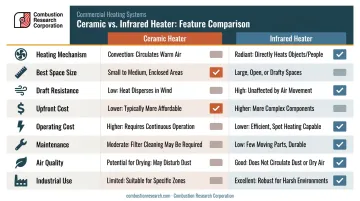
Ceramic vs. Infrared Heater: Quick Comparison
| Factor | Ceramic Heater | Infrared Heater |
|---|---|---|
| Heating mechanism | Convection — warms air via fan | Radiation — warms objects and people directly |
| Best space size | Up to ~150 sq ft | Any size, including 100,000+ sq ft |
| Drafts and open doors | Major efficiency loss | Minimal impact on comfort delivery |
| Upfront cost | Lower (consumer units) | Moderate to higher depending on scale |
| Operating cost | Higher in large/open spaces | Lower; documented 30–50% savings vs. forced-air heating |
| Maintenance | Fans, filters, moving parts | Fewer service points; no combustion filters on gas tube systems |
| Air quality | Circulates dust and allergens | Does not disturb ambient air |
| Industrial use | Not appropriate | Primary choice for commercial/industrial |
What Is a Ceramic Heater?
Ceramic heaters are convection-based electric appliances. They pass current through a PTC (positive temperature coefficient) ceramic element, which self-regulates by increasing electrical resistance as the element heats up, automatically limiting power draw and preventing overheating. A fan then pushes heated air into the room.
In a tight, well-insulated space, this works reliably. The room fills with warm air, temperatures equalize, and the heater cycles on and off to maintain setpoint. Purchase cost is low, and operation is straightforward.
The limitations show up quickly outside that scenario:
- Drafts and open doors displace the heated air immediately, forcing the heater to start over
- High ceilings collect warm air near the roof, leaving occupant-level temperatures well below setpoint
- Fan noise is a minor but persistent drawback in quiet environments
- Air circulation distributes dust and allergens throughout the room
- No path to commercial-scale heating — ceramic heaters are supplemental tools that cannot serve as primary systems in large or high-traffic facilities
Where Ceramic Heaters Fit
Ceramic heaters belong in small residential rooms, personal office spaces, and similar enclosed environments where the goal is gradual, ambient air warmth across a few hundred square feet. They work as a supplement to a primary heating system — not as the system itself. For warehouses, hangars, service bays, or any facility with open doors and high ceilings, a different heating approach is needed.
What Is an Infrared Heater?
Infrared heaters emit electromagnetic radiation in the infrared spectrum — the same mechanism as heat from the sun. That energy travels through air without warming it and is absorbed by whatever solid surface it reaches: floors, walls, equipment, and people. The air temperature is largely irrelevant to comfort because the warming happens at the surface level.
This distinction explains why infrared heaters maintain effective, consistent heating even when:
- Large bay doors open and close repeatedly
- Drafts move through the space
- Ceilings are 20, 30, or 40 feet high
- The building envelope has significant infiltration
Two Primary Categories
Electric infrared heaters (quartz or ceramic emitters) are compact, plug-in or hardwired units used for spot heating in residential settings, patios, or small commercial spaces. They heat instantly but are limited in scale.
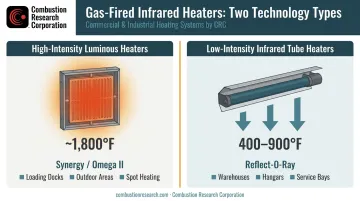
Gas-fired infrared systems divide into two distinct types:
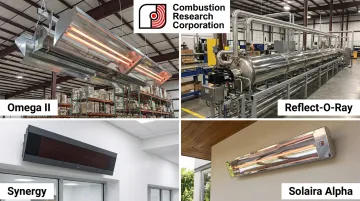
High-intensity luminous heaters — ceramic burner tiles that glow visibly, operating at emitter temperatures around 1,800°F. Used for targeted spot heating, outdoor areas, or high-bay applications requiring concentrated heat. Combustion Research Corporation's Synergy line falls into this category, reaching full operating temperature in under one minute — well-suited for loading dock doors, entry vestibules, or individual work cells.
Low-intensity infrared tube heaters — the dominant choice for full-facility industrial heating. A burner sends combustion gases through a long tube (typically 400–900°F per ASHRAE data), which radiates heat downward through a reflector toward the floor and occupants. No open flame exposure at floor level. Combustion Research Corporation manufactures two product lines engineered for these environments: the Omega II (power-vented) and Reflect-O-Ray (vacuum-vented), both built for demanding commercial and industrial environments.
Why Infrared Works in Large, Drafty Spaces
Because infrared radiation travels as electromagnetic waves rather than through air movement, drafts don't interrupt heat delivery to occupants. What they do affect is the building's overall heat load — every door cycle imports cold air that must eventually be offset. A forced-air system has to reheat the entire air volume after each door opening, which takes several minutes. A radiant system recovers within seconds, because the thermal mass of floors and equipment retains heat between cycles.
Use Cases for Infrared Heaters
Infrared heating applies across a wide range of environments:
- Residential and light commercial spaces: patio spot heating, single-bay garages, small workshops
- Industrial and commercial facilities: warehouses, aircraft hangars, auto dealership service bays, manufacturing plants, shipping docks, ice arenas, natatoriums, animal confinement facilities, and greenhouses
What these industrial applications share: large volume, high ceilings, or frequent door cycling — conditions where convective heating struggles and infrared consistently delivers.
Ceramic vs. Infrared Heater: Which Is Better?
The honest answer: it depends on the space. But the decision framework is straightforward once you apply four practical criteria.
Space Size and Insulation
Ceramic heaters are efficient only in small, well-insulated, enclosed rooms. A peer-reviewed 2017 warehouse study found that an 8°C vertical temperature difference in a high-ceiling building required 38% more heating energy to maintain setpoint — exactly the penalty you pay when warm air stratifies near the roof instead of serving occupants at floor level. That's the core inefficiency of convective heating in large spaces.
Infrared eliminates most of that penalty by bypassing the air column entirely.
Energy Efficiency
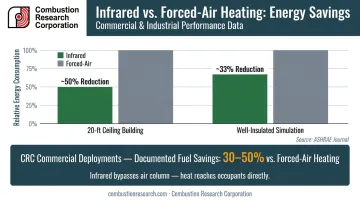
For high-bay commercial and industrial facilities, ASHRAE Journal research on gas-fired radiant heaters versus conventional unit heaters found approximately 50% lower energy use in a 20-ft test building and roughly 33% lower use in a more-insulated simulation. CRC's documented commercial deployments consistently report 30–50% fuel savings over forced-air systems across warehouses, hangars, and service bays.
The U.S. Department of Energy confirms that electric resistance heating converts 100% of incoming electricity to heat — applicable to both electric ceramic and electric infrared heaters at the unit level.
The efficiency difference emerges in how effectively that heat reaches and stays with occupants. In large or drafty spaces, that's where infrared holds the clear advantage.
Air Quality and Comfort
Ceramic heaters with fans circulate whatever is in the air: dust, allergens, fine particulates from floors and shelving. In environments where air quality matters — animal confinement facilities, natatoriums, facilities serving workers with respiratory sensitivities — fan-forced heating is a meaningful liability.
Infrared heaters don't disturb air at all, and they don't artificially dry it the way fan-forced systems can. This is a mechanical distinction, not a clinically proven health outcome, but in practice it has real consequences in specific settings:
- Ice arenas: warm circulating air accelerates surface melt
- Natatoriums: radiant heating reduces evaporative load on dehumidification systems
Maintenance and Total Cost of Ownership
| Component | Ceramic Heater | CRC Infrared Tube Heater |
|---|---|---|
| Fan motor | Present — wear point | Not present |
| Combustion air filter | N/A | Not required (Omega II, Reflect-O-Ray) |
| Belts/ductwork | N/A for portable units | Not applicable |
| Tube warranty | N/A | 10-year (internally created corrosion) |
| Burner controls | N/A | 3-year warranty |
For facilities where service requires lift equipment to reach ceiling-mounted systems, eliminating filter-driven service cycles and fan maintenance translates directly to lower operating costs over the system's life.
Situational Recommendations
- Choose ceramic if you need low-cost supplemental warmth in a small, enclosed, well-insulated residential room
- Choose infrared for any space that is large, high-ceilinged, drafty, open-door, or subject to significant air infiltration — and for any application where air quality, silence, or long-term energy savings are priorities
- For commercial or industrial heating: infrared is the functionally appropriate choice without exception
Real-World Applications: Where Each Heater Excels
In residential settings, the difference between ceramic and infrared is mostly comfort preference. In commercial and industrial settings, the wrong choice means persistent cold zones, wasted fuel, and recurring service costs year after year.
The Industrial Case: Service Garages and Warehouses
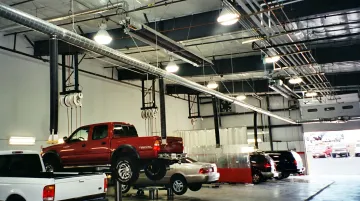
Consider an auto dealership service bay with 18–20 ft ceilings and bay doors that open every time a vehicle enters or exits. A forced-air unit heater has to reheat the entire air volume of the bay after each door cycle — and that warm air has nowhere useful to go except straight up to the ceiling. Workers at floor level remain cold while the HVAC system runs continuously.
A 2007 ACEEE case study documented exactly this scenario in an auto-service garage conversion: after replacing forced-air gas unit heaters with infrared heaters, the facility recorded 7,800 therms saved per year and more than $8,300 in annual savings, against a project cost of approximately $40,000. Notably, the post-installation year was colder than the baseline year — meaning the actual performance advantage was even stronger than the numbers suggest.
That case study also includes a cautionary failure: a poorly insulated machine shop with 30–45 ft ceilings where an infrared installation underperformed because of undersized equipment, incorrect mounting heights, and unchanged thermostat practices. Equipment selection, proper sizing, and system design matter as much as technology selection.
Aircraft Hangars and High-Bay Warehouses
Scale this up further — aircraft hangars and high-bay warehouses — and the heating challenge becomes even harder to solve with convective systems. High ceilings (often 30–50 ft), massive doors that open for extended periods, and large uninsulated volumes create conditions where warm air rises before it ever reaches occupants. Ceramic heaters aren't engineered for these spans, and even commercial forced-air unit heaters struggle: the warm air they produce rises immediately, creating large temperature gradients from floor to ceiling.
Ceiling-mounted low-intensity infrared tube heaters address this by delivering heat via radiation to the floor, equipment, and occupants regardless of what the air is doing. CRC's Reflect-O-Ray 6.0 EDS vacuum system is recommended for ceilings 20 ft and above. Its vacuum-pressure design provides rapid thermal recovery after door cycles, and multiple units can share a single roof penetration — reducing installation complexity in large-span structures.
When to Call in Engineering Support
The difference between a successful infrared installation and an underperforming one often comes down to correct sizing and layout. For facilities with complex floor plans, multiple occupancy zones, or frequent door cycling, proper heat loss calculations and system design are essential.
Combustion Research Corporation has engineered low-intensity infrared heating systems for commercial and industrial facilities since 1965. Their product lines cover the primary facility types discussed in this comparison:
- Omega II — power-vented gas radiant tube, for shops and service bays
- Reflect-O-Ray — vacuum-vented gas radiant tube, for hangars and high-bay warehouses
- Synergy — high-intensity ceramic infrared, for facilities requiring zone or spot heat
- Solaira Alpha — commercial electric infrared, for facilities without gas infrastructure
If you're evaluating heating options for a warehouse, hangar, service garage, or similar facility, CRC's engineering team can provide heat loss calculations, system design, and specification documentation before construction begins. Reach them at 888-852-3611 or at combustionresearch.com.
Frequently Asked Questions
Which is better: a ceramic heater or an infrared heater?
Neither is universally better — the right choice depends on the application. Ceramic heaters work in small, enclosed spaces needing ambient warmth. Infrared heaters are the stronger option for large, open, drafty, or industrial spaces where energy efficiency and air quality are priorities over upfront cost.
What is the healthiest heater to use?
Infrared heaters don't circulate air, so they don't redistribute dust or allergens the way fan-forced ceramic heaters do. They also don't reduce indoor humidity. In air-quality-sensitive commercial environments — animal confinement facilities, natatoriums, aquatic centers — infrared is the better choice.
Are ceramic heaters suitable for large industrial or commercial spaces?
No. Ceramic heaters are designed for small enclosed rooms. In large, high-ceiling, or drafty industrial environments, the warm air they produce rises and dissipates before reaching workers at floor level, making them energy-inefficient and functionally inadequate for commercial use.
Do infrared heaters dry out the air?
Infrared heaters do not dry the air because they heat objects and people directly without warming or circulating the surrounding air. Ceramic heaters with fans, by contrast, can reduce indoor humidity through continuous air circulation.
What is the lifespan difference between infrared and ceramic heaters?
Industrial-grade infrared tube heaters — particularly vacuum-vented systems without combustion air filter requirements — have longer service lives and lower maintenance demands than ceramic heaters, which contain fans and other wear-prone components. Combustion Research Corporation's Omega II and Reflect-O-Ray lines carry a 10-year radiant tube warranty and a 3-year burner control warranty.
Can infrared heaters be used effectively in garages and warehouses?
Yes — they're the preferred solution for these environments. Ceiling-mounted infrared tube heaters deliver consistent radiant warmth at floor level without being affected by drafts, open doors, or high ceilings that defeat convective heating systems. Proper sizing and layout are critical to achieving the documented 30–50% energy savings over forced-air alternatives.