Introduction
Few commercial spaces punish a mechanical system like a natatorium does. High humidity, chemical off-gassing, and corrosion attack the same room at the same time, and the HVAC system sits at the center of all three problems.
Get the design wrong, and the consequences aren't cosmetic. Mold takes hold in wall cavities, structural steel corrodes, and chloramine byproducts irritate swimmers and spectators alike. Energy bills climb because the system fights moisture it was never sized to handle.
This guide walks through the core design factors that actually matter: humidity and pressurization control, ventilation strategy, chloramine mitigation, and envelope protection. It also covers the equipment mistakes that show up again and again in existing facilities.
Key Takeaways
- Target 50-60% relative humidity with air temperature 2-4°F above pool water temperature
- Maintain -0.05 to -0.15 in. w.c. negative pressure to stop moisture migration into walls and roofs
- Use low, source-capture exhaust near the water surface, not ceiling exhaust, to control chloramines
- Specify dedicated pool dehumidifiers rather than standard air conditioners for combined load control
- Pair pool-water heat recovery with radiant deck heating to cut operating costs
Why Natatorium HVAC Design Is Uniquely Challenging
Most commercial HVAC systems deal with one or two variables. A natatorium hits you with four at once:
- Moisture control — constant evaporation from a large water surface
- Chemical off-gassing — chloramines forming continuously from chlorine and swimmer waste
- Corrosion protection — humidity and chlorine compounds attacking metal components and structural elements
- Year-round energy load — the room needs conditioning 365 days a year, regardless of outdoor weather
Balancing all four demands specialized expertise that's hard to come by. Few mechanical engineers get to design more than one or two natatoriums in a career, and dedicated guidance was thin for decades, too.
ASHRAE didn't give indoor swimming pools their own chapter in the HVAC Applications Handbook until the 2019 edition. That's when the topic was pulled out of the general Places of Assembly section and expanded into standalone coverage of water chemistry, envelope design, airflow, and source-capture exhaust.
That gap in specialized experience shows up in built facilities. A design can satisfy every applicable code and still deliver poor air quality if one variable is off.
Move the exhaust to the ceiling instead of the deck, or get the pressurization sequence wrong. Either mistake causes the whole system to underperform, even though every line item on the mechanical schedule checks out.
Core Design Factors for a Reliable Natatorium HVAC System
Temperature & Humidity Control
Evaporation drives everything in a natatorium. Warmer pool water increases the vapor pressure differential between the water surface and the surrounding air, which raises the latent load your dehumidification equipment has to remove.
Features beyond a standard flatwater pool add substantially more evaporation:
- Splash pads and spray features
- Wave pools and moving water attractions
- Bucket drops and other high-agitation elements
Design targets:
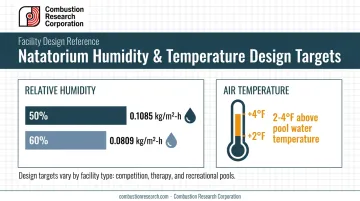
- Relative humidity: 50-60%
- Air temperature: 2-4°F above pool water temperature
These ranges shift by facility type — competition pools run cooler, therapy pools run warmer, hotel and kids' swim school pools sit somewhere in between.
The RH setpoint isn't just a comfort number. At 25°C water and air, published evaporation data shows 0.1085 kg/m²-h at 50% RH versus 0.0809 kg/m²-h at 60% RH, according to research published in ASHRAE Transactions. Dropping the RH target by ten points meaningfully increases the moisture load your equipment has to remove, along with the energy needed to do it.
Don't forget spectator loads. Swim meets pack bleachers with people who add their own latent heat, and that load needs its own sizing calculation rather than a rough add-on to the standard operating mode.
Pressurization Control
A natatorium needs to run slightly negative compared to adjacent spaces and the outdoors. Otherwise, humid air pushes into wall cavities and roof assemblies, where it condenses and causes rot, corrosion, and eventually envelope failure.
The recommended control method pairs a variable-speed exhaust fan with a differential pressure sensor in the space. This setup matters most in cold climates, where the stakes for envelope failure run higher.
ASHRAE guidance supports a target range of -0.05 to -0.15 in. w.c. relative to surrounding areas, with excess exhaust airflow set at roughly 10% above supply, based on ASHRAE Journal's 2017 pool ventilation guidance.
Ventilation Rates & Air Distribution
ASHRAE 62.1 provides the baseline ventilation numbers:
| Zone | Outdoor Air Rate |
|---|---|
| Pool and wet deck area | 0.48 cfm/ft² |
| Dry deck area | 0.06 cfm/ft² |
| Spectator zone | 7.5 cfm/person + 0.06 cfm/ft² |
Circulation rates run separately from these outdoor air figures. Aim for 4-6 air changes per hour in the main pool area and 6-8 ACH in spectator zones, calculated from total room volume.
Good duct layout matters as much as the numbers themselves:
- Deliver supply air low, toward the breathing zone at deck level and water surface
- Direct air toward exterior glass and doors to keep those surfaces above the dew point
- Distribute air throughout the room to eliminate stagnant corners
- Position returns strategically to support the overall airflow pattern
- Keep supply diffusers away from returns to avoid short-circuiting
Getting this right on paper is one thing. Some design teams now validate it with computational fluid dynamics (CFD) before construction.
The Scheels Aim High Big Sky Aquatic and Recreation Center used CFD modeling to check airflow around pools and occupied zones before finalizing the mechanical design. The process caught distribution issues that a load calculation alone would have missed.
Indoor Air Quality & Chloramine Control
Understanding the Breathing Zone & Source-Capture Exhaust
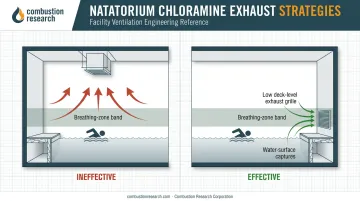
Chloramines and other disinfection byproducts are heavier than air. They settle low, right where swimmers and pool-deck staff are breathing, according to the CDC's guidance on chloramines and pool operation. That's why ceiling exhaust, while useful for pulling out humidity, does almost nothing for air quality.
Low returns without a dedicated source-capture path make things worse, not better. Chloramine-laden air gets pulled back through the system, corroding evaporator coils and compressors while recirculating contaminants straight back into the breathing zone. This corrosive exposure is why natatorium mechanical rooms typically spec stainless-steel-rated equipment, heating systems included, over standard powder-coated units that degrade quickly under chloramine exposure.
The single most important IAQ decision on any natatorium project comes down to two moves:
- Deliver the cleanest, most conditioned supply air directly to the deck and breathing zone
- Exhaust contaminated air from a low point near the water, not the ceiling
Coordinating Water Chemistry & Air System Design
Here's a misconception worth killing early: that sharp chlorine smell doesn't mean too much chlorine. It means too little free chlorine relative to the ammonia and organic waste swimmers bring into the water, which lets chloramines form and off-gas.
Mechanical engineers, pool operators, and aquatics staff need to coordinate early and often. One recurring failure pattern: a system designed around an 82°F pool operating temperature that gets run at 86-88°F in practice, throwing off every load calculation the mechanical design was based on. Confirm actual operating setpoints with facility staff before finalizing equipment sizing, not after.
Air-side design isn't the whole story, though: water-side technologies help too. UV treatment breaks down chloramines at the source, reducing the burden on the air-side system rather than replacing it.
Condensation Control & Energy Efficiency Strategies
Preventing Condensation & Protecting the Building Envelope
Dew point math explains most envelope failures. A typical 82°F room at 50% RH has a dew point in the low-to-mid 60s°F. Any surface below that temperature (windows, thermal bridges, poorly insulated framing) will collect condensation.
Two design moves address this directly:
- Vapor retarder placement: install on the warm side of insulation across every wall and ceiling assembly, sealed at every seam. In cold climates, this is the only reliable way to stop vapor migration into the envelope.
- Glass blanketing: direct supply air at exterior glass and doors at roughly 3-5 cfm per square foot of glass to keep surface temperatures above the dew point.
Reducing Operating Costs Through Energy Recovery & Smart Heating
Evaporation drives the bulk of a facility's water heating cost, which makes heat recovery one of the highest-return investments available:
- Glycol runaround loops transfer sensible heat between exhaust and outdoor air streams without mixing corrosive exhaust into supply air
- Refrigerant-based recovery captures latent heat at the dehumidifier's evaporator and redirects it to pool water or supply air instead of discarding it
Exhaust-air heat recovery preheats or pre-cools incoming outdoor air, trimming the overall heating and cooling load the rest of the system has to carry, particularly valuable in cold climates with long heating seasons.
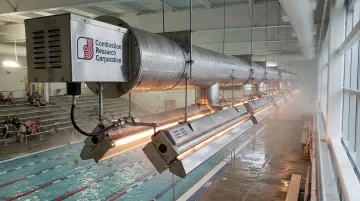
Radiant heat plays a supporting role worth factoring in. Ceiling-mounted, low-intensity infrared systems warm the deck, spectator seating, and occupants directly instead of heating the air mass. That matters because overheating the air relative to the water surface increases evaporation, which raises dehumidification load.
CRC's stainless steel Reflect-O-Ray systems are built for this environment, with corrosion-resistant burner housings and aluminized steel tubing designed to survive chloramine exposure that destroys conventional unit heaters within months. Facilities report 30-50% energy savings compared to forced-air heating, plus reduced strain on the dehumidification system since radiant heat doesn't add airflow-driven moisture or disturb settled particulates.
One safety note that's easy to miss: any gas-fired equipment near the pool needs to be engineered so chlorine-laden air can't mix with combustion gases, which forms corrosive hydrochloric acid.
Vacuum-fired systems, where the exhauster draws combustion gases under negative pressure rather than pushing them out, address this directly. If a tube or flue connection ever leaks, the pressure differential pulls ambient air inward instead of pushing exhaust outward, keeping contaminated air out of the combustion path.
Avoiding Common Natatorium HVAC Mistakes & Choosing the Right Equipment
The same handful of mistakes show up across natatorium projects, new construction and retrofits alike:
- Ceiling exhaust instead of low, source-capture exhaust
- Low returns with no dedicated source-capture path
- Standard air conditioners substituted for dedicated pool dehumidifiers
- Conflicting airflow patterns that create stagnant zones
- Poor communication between aquatics staff and the HVAC design team
Standard air conditioners fail here for a specific reason: they're built to manage sensible temperature, cycling off once the thermostat is satisfied. Pool evaporation doesn't stop when the air temperature hits setpoint.
A dedicated pool dehumidifier controls latent and sensible loads together, continuously. That continuous control protects the building envelope over time.
Equipment specification checklist:
- Corrosion-resistant coil coatings rated for chloramine exposure
- Microprocessor controls with remote monitoring capability
- Direct-drive plenum fans with VFDs for pressure and airflow modulation
- Pool-water heat recovery integration
- Stainless steel construction on any heating equipment mounted near the pool deck, including radiant tube heaters used for deck-level comfort heating
Frequently Asked Questions
What humidity level should a natatorium maintain?
Target 50-60% relative humidity. Dropping below 50% sharply increases evaporation and heating costs, while the higher end of the range is often preferred during summer months.
What is the ideal air temperature for an indoor pool room?
Keep air temperature 2-4°F above the pool water temperature. Competition pools typically run cooler, while therapy and recreational pools trend warmer within that range.
Why can't I just use a regular air conditioner for my natatorium?
Standard ACs manage sensible temperature only and cycle off once the thermostat is satisfied. Dedicated pool dehumidifiers control combined latent and sensible loads continuously, protecting the building envelope long-term.
How many air changes per hour are required in a natatorium?
Aim for 4-6 ACH in the main pool area and 6-8 ACH in spectator zones, calculated from total room volume rather than outdoor air rates alone.
What causes the strong chlorine smell in indoor pools, and can HVAC design fix it?
That smell comes from chloramines off-gassing, not excess chlorine. Proper source-capture exhaust and air distribution reduce it noticeably, especially combined with good water chemistry management.
How can I reduce energy costs in my natatorium HVAC system?
Pool-water heat recovery, glycol runaround loops, and avoiding excess outdoor air all cut costs. Radiant deck and spectator heating, such as CRC's stainless steel radiant tube systems built to resist chloramine corrosion, adds further savings without increasing dehumidification load.